
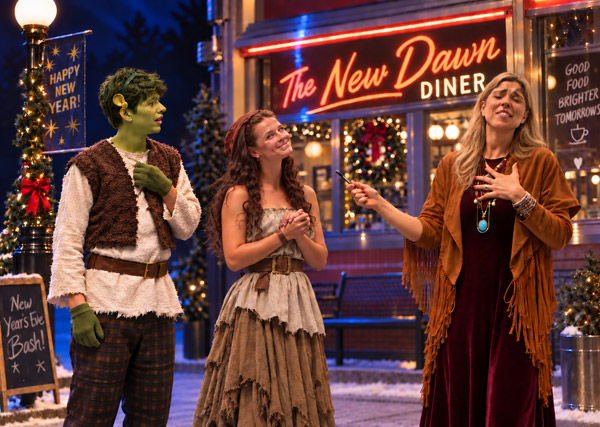
(Left to Right) Emre Celik, Emma J. Allison, and Jessica Braynor
(WEST WINDSOR, NJ) -- Sixty seconds before the ball drops on a New Jersey diner packed with lodge brothers, lovesick teenagers, a tempestuous Hollywood couple, and a writers' group still arguing about a chicken, playwright and director Dan Maurer's newest work asks a simple question with complicated answers: what happens when you finally say the thing you've been holding back?
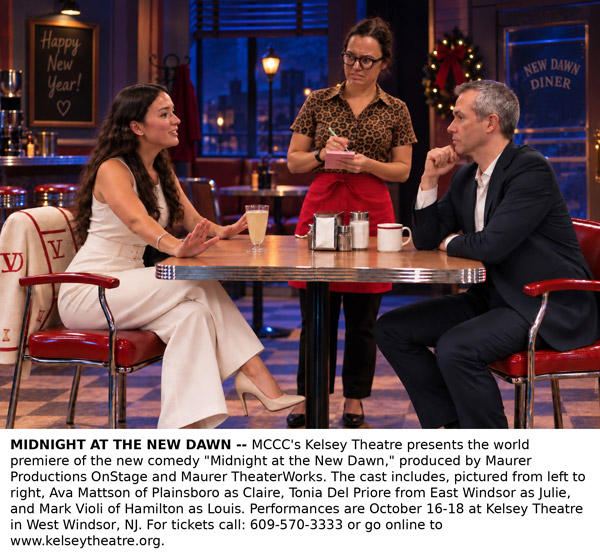
Midnight at the New Dawn, an original ensemble comedy written and directed by Maurer, receives its world premiere October 16–18, 2026 at Kelsey Theatre on the West Windsor campus of Mercer County Community College — a co-production between the newly formed Maurer TheaterWorks and the award-winning Maurer Productions OnStage (MPO), reuniting an NJACT Perry Award–winning creative team for the first time in more than a decade. Set in a diner on New Year's Eve and structured around a live-streaming relationship web series that turns four couples' private reckonings into public spectacle, Maurer describes the work as "Neil Simon with a Wi-Fi connection."
We sat down with Dan Maurer to talk about the twelve-year road back to Kelsey Theatre, why a diner, why now, and what it took to get nineteen actors and a script still finding its shape through a summer of table reads and a rehearsal room full of opinions.
You and Maurer Productions OnStage go back to 2004, when your brother John and his wife Diana, founded the company. What does it mean to be back at Kelsey with them after twelve years away?
Everything, honestly. MPO was where I learned how to do this — producing, directing, all of it, starting with The Foreigner, which began pre-production in 2004. I stepped away in 2014 to focus on my writing, and that wasn't a small decision. But this play only exists because of everything I absorbed in that building and with that team. Coming back with an original piece, co-produced with MPO and Maurer TheaterWorks — the new company I've founded to develop new work — that's not nostalgia. That's my personal theater journey coming full circle.
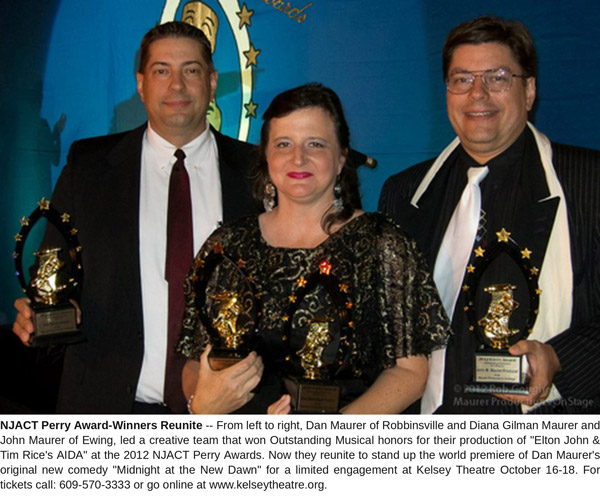
The creative team reuniting after all these years is one of the real headlines here. What was it like calling people back for this?
It didn't feel like a reunion tour. It felt like everyone had just been waiting for the right piece and the right opportunity to come along so we could all work together again, and it clicked into place fast. We've got people who directed, did sound design, and set design, and produced shows together, won Perry Awards together — there's an easy and mutual respect that never went away. That mattered more than I expected once we got into the room, because this script asks a lot of everybody. It's a big ensemble, it moves fast, and it needs people who already trust each other to pull it off.
Let's talk about the diner. Why does this story live there, and why New Jersey specifically?
Because a diner is the only place in New Jersey where a divorcing couple, a washed-up celebrity, a teenage romance, and a lodge rivalry can all plausibly order pie at the same time. It's democratic. Everybody ends up in a diner eventually — that's true of Jersey in a way it isn't anywhere else. I also just wanted to write something that sounds like where I'm from. The rhythm, the sarcasm, the way people here show love by giving you grief. That's not incidental to the comedy. That is the comedy.
The play's been pitched as Love Actually in a Jersey diner instead of London — multiple couples, everyone's story unfolding simultaneously. What drew you to that structure?
I like watching how differently people carry the same problem. Every couple in this diner is circling some version of the same question — do I say the true thing, or do I keep managing the story I've been telling? A couple wrestling with trust, a marriage dissolving in real-time because one person wants to become someone else, two exes who did real damage to each other, two teenagers who don't yet know how high the stakes really are. Put them all in one room with a countdown clock, and the comedy and the ache come from the same place.
"Neil Simon with a Wi-Fi connection" has become the shorthand for the show. What does that phrase mean to you as a description of the writing itself?
Simon wrote comedy that – at its best – never let you forget these were real people with real wounds — the jokes were the delivery system for something true, not a substitute for it. I wanted to try my hand at that same engine, but built for right now, when everybody's private life has a potential audience. The web series inside the play, Truth Be Told, isn't a gimmick bolted onto an old-fashioned comedy. It's the modern version of the thing that's always driven comedy — everybody performing, right up until the moment they can't anymore.
You've said the play grew out of shorter pieces you had staged around the state. Walk us through that evolution.
Several of these characters started as ten- and twenty-minute plays that got readings or productions at theaters around New Jersey over the years. I kept noticing that the strongest ones all lived in the same emotional neighborhood — people who couldn't say the thing out loud. At some point I stopped thinking of them as separate plays and started thinking of them as separate tables in the same diner. Once I had that image, the short pieces stopped being finished works and started being raw material.
Once you had a draft, what did the development process actually look like?
Long. I spent the spring writing the first draft and the summer doing table reads, and not just in-house — we brought in New Jersey producers, directors, and playwrights whose judgment I trust, people who've been in this community for decades, and asked them to tell me what wasn't working. That's a harder thing to sit through than people think. You hear "this storyline doesn't fit" or "we don't buy this turn" and you have to actually listen instead of defending the draft. We did a full private luncheon and table read specifically to stress-test it in front of people who had no reason to be polite to me.
And that kept going once actors were cast?
Absolutely, and honestly that's where some of the best material came from. I don't hand actors a finished blueprint and ask them to execute it. Once we were in the room, people started advocating for their characters — pushing back on a line, asking why someone would do something, arguing for a beat that protected who their character was. That's not a director losing control of the script. That's the script getting better. Some of the most specific, human moments in this play exist because an actor said "I don't think she'd say that" and they turned out to be right.
Without spoiling anything — what should audiences walk in expecting, and what do you hope they walk out with?
Expect to laugh a lot, harder than you think a play about relationships should make you laugh. And expect to recognize somebody at that counter — maybe more than one somebody. I hope people walk out having had a genuinely good time and thinking about the phone call they've been putting off, or the thing they've been afraid to say to someone. That's the whole engine of the play. Everybody in that diner is one honest sentence away from a different life. Many people are.
Last question. It's opening night, curtain's about to go up at Kelsey. What are you feeling?
Grateful, mostly. This is a room full of people I've worked with for a long while – some for over twenty years. We're telling a story I'm very proud of, in the theater where I actually learned how to do all of this. Whatever else happens, it already feels like a success.
Midnight at the New Dawn runs one weekend at Kelsey Theatre (1200 Old Trenton Road) in West Windsor, NJ on the campus of Mercer County Community College. Performances are on Friday, October 16 at 8:00pm; Saturday, October 17 at 2:00pm & 8:00pm; and Sunday, October 18 at 2:00pm. Tickets are $24 for adults and $22 for students and seniors, available at www.kelseyatmccc.org, by phone at 609-570-3333, or at the Kelsey Theatre Box Office. Free parking is available next to the theatre, which is wheelchair accessible.


Since bringing home the Gold and Silver medals at the 2016 Rio Olympic Games, Laurie Hernandez has gone on to win the coveted Mirror Ball trophy on “Dancing with the Stars” Season 23 and her first book titled “I Got This: To Gold and Beyond” chronicling her journey thus far was published in 2017, hitting the New York Times Best Sellers list. In 2018, she released a children’s picture book “She’s Got This,” also a New York Times Best Seller, while serving as a Literary Champion to promote readership as a path to leadership, and Mattel created Laurie Hernandez “Shero” Barbie to honor her.

A rare conversation on what matters most. We struggle to stay present. We wait for the world to become peaceful. And too often, we feel powerless to change any of it. What if power, presence, and peace are closer than we think? What could power, presence, and peace actually look like in your life?

UCPAC invites children in Pre-K through third grade and their families to celebrate Hispanic Heritage Month! Join us for story time with classic books read in both Spanish and in English by community leaders. Pages from the books will be projected onto our screen, as well as read aloud. Admission is free, but tickets are required.

Superstar saxophonist Kenny G has been a staple in pop and contemporary jazz since the 1980s, with crossover hits such as “Songbird” that have made him a favorite of fans worldwide who love his expressive melodies and emotional solos.

Fights Worth Fighting by Dolph Lundgren is a powerful and unflinchingly honest memoir from one of the most enduring icons of action cinema.