
By the end of the 1820s, Sam Patch was one of the most famous men in America. His feats of daring in Paterson, New Jersey were reported in the nation's newspapers as he made a spectacular leap from atop the great waterfall on the Passaic River. So legendary was his fame that President Andrew Jackson named his horse after him.
Born in 1799 in Pawtucket. Rhode Island, young Patch was named for his brother Samuel, who had died in infancy. He soon began work as a cotton spinner in the textile mills at a time when the scourge of child labor was a common practice. Seeking relief from the tedium of the mills and the warm summer sun, the boys swam for fun in the Blackstone River. Sam first gained fame among his peers by jumping off the mill dam into the swirling waters below.
As a young man in his twenties, employed in the Paterson, New Jersey mills, he leapt from the “Great Falls” of Paterson – a height of 70 feet on the Passaic River. As news of his daring jumps achieved renown, he became known as the “Jersey Jumper.” The demonstration was so popular he repeated it at least two more times before ever-increasing crowds. Paul Johnson’s well-researched biography Sam Patch (2003) describes the defiant nature of the jump that would launch his celebrity and career as a daredevil: “the jump was a challenge to the ambitions and pretensions of a Paterson entrepreneur.” Patch harbored the resentments of many of his class and took it upon himself in September of 1827 to spoil the grand celebration Timothy Crane planned for his new “Forest Garden” amusement park. He named his new ariel walkway, “The Dewitt Clinton Bridge,” and it was about to be inaugurated across the falls of the Passaic River, when Sam Patch stole Crane’s thunder. According to Johnson, as the bridge was pulled into place,
Tim Crane looked up for applause, but the cheering was broken by shouts from the south bank. For there was Sam Patch, standing erect on a rock at the edge of the cliff. Sam spoke to the people near him. Then he stepped off.
It was a straight seventy-foot drop to the water below, and Sam took it in fine Pawtucket style. At the end he brought up his knees, then snapped them straight, drew his arms to his sides, and went into the water like an arrow.
The hushed crowd stared into the waters, believing that no man could survive such a fall. But when Sam’s head broke the surface and he casually swam to the shore, they cheered exuberantly, much to the dismay of Tim Crane, whose ceremony had been ruined.
The mill workers in Paterson, and other mill towns were the sacrificial lambs of the industrial revolution, working 11-hour days, six days a week – all to create enormous wealth for the handful of industrialists with the capital to build the dams and factories. While Sam Patch had no sense of class consciousness, he had a surfeit of bitterness, fueled by rum (most accounts of his life include references to his addiction to alcohol), and seldom passed up an opportunity to wreak revenge on those who would exploit him as cheap labor.
The following summer, Patch jumped again in Paterson. This time it was on the Fourth of July and the exhibition attracted about 4,000 spectators in a town of just 6,000. It also afforded Patch the opportunity to coin a catchphrase that he would use for the remainder of his jumping career. It was a simple expression: “Some things can be done as well as others.” According to Johnson, he was paid fifteen dollars for this feat of daring, and it was the point at which Patch abandoned the mills for a life of intrepid fame.
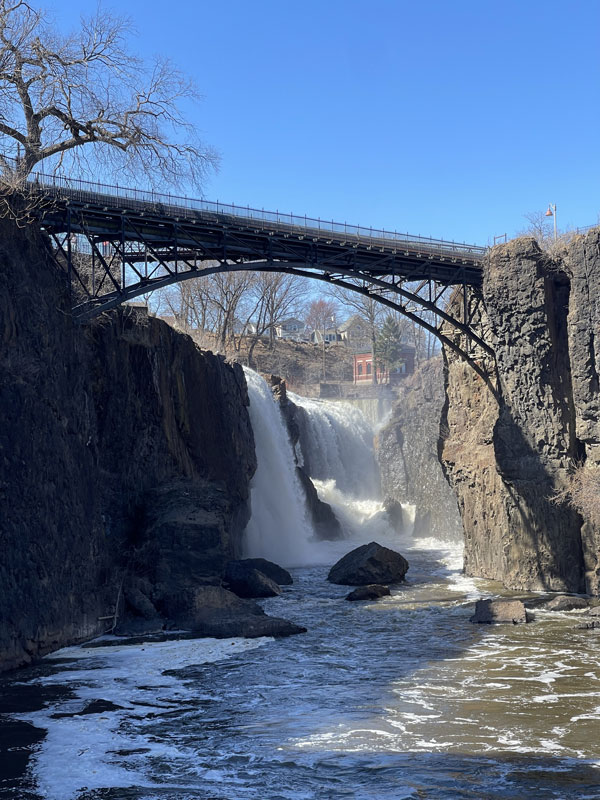
Paterson Great Falls National Historical Park. Photo by MHK Lens from Shutterstock
While the amazing feats of Sam Patch thrilled many, there were those who thought the spectacle was unseemly. In staid Bellows Falls, Vermont the Intelligencer remarked, There were from 6 to 10,000 persons assembled at Paterson, to see Sam Patch leap from Passaic Falls. This is in bad taste, for although there is some tact and management to the feat, it is still unnecessarily sporting with human existence, and all such bravadoes should be discountenanced. Rational, scientific and even daring exploits for rational objects may be encouraged, but what is there in a leap over a cataract of 90 feet? Danger and desperation.
With Sam Patch’s national celebrity came an invitation to leap from the nation’s most monumental wonder, Niagara Falls. Johnson’s biography notes, Gentlemen in Buffalo, through friends in New York City, invited Sam to leap at Niagara Falls in October 1829. We know also that when Sam set out on his journey to Niagara, he was drunk nearly all the time.
More accessible with the completion of the Erie Canal, the great cataract had become America’s favorite natural wonder. Within just a few years hotels and other tourist accommodations sprawled just beyond the roaring waters. Exhibitions were created to demonstrate the power of this geological marvel. For the amusement of tourists, various items were sent over the falls. Johnson describes one such event in September of 1827: The innkeepers dressed up the old lake schooner Michigan as a pirate vessel. They loaded the ship with live animals: a buffalo, two bears, a dog, a cat, a raccoon, a fox, a small flock of geese and a tethered eagle – along with effigies of buccaneers, politicians, and the stage villain Blue Beard. Before a crowd estimated at somewhere between ten thousand and fifty thousand persons, they sent the ship over the Horseshoe Falls.
The following year the festivities included sending more ships over the cataract, dynamiting the falls, and, lastly, a leap by Sam Patch.
Patch had been in Buffalo for a few days and was, reportedly, inebriated most of the time. Nevertheless, he accomplished a flawless jump on October 7th. A Canadian newspaper described his performance: Sam walked out clad in white, and with great deliberation put his hands close to his sides and jumped from the platform into the midst of that vast gulf of foaming waters from which none of human kind had ever emerged in life.
He planned a second jump ten days later and spent his days, until then, drinking in Buffalo’s bars. In the evenings he was on display at a local museum where, according to Johnson, the price of admission had to be reduced because he was always senselessly drunk.
Somehow, he acquired a bear cub which he kept on a chain. It accompanied him everywhere.
A broadside appeared in which he promised to jump from nearby Goat Island “from a height of 120 to 130 feet. He actually leaped from “a shelving rock midway between the highest point of Goat Island and the water, more than half the height of the falls,” according to Jenny Parker’s biographical essay in Rochester (1884).He was promised the income from the tolls on the Goat Island Bridge for his trouble. Paul Johnson reports that the fee amounted to .25 per person – “a good payday for Sam Patch.”
A temporary scaffold had been built on the Biddle Stairs to allow Patch to ascend higher than in any of his previous jumps. The stairs had been constructed on Goat Island by wealthy banker Nicholas Biddle to permit his visitors to enjoy the majesty of Niagara Falls. A spectator wrote this report for the United States Gazette (Oct. 27, 1829) in the afternoon on October 17th: The day was lowering and rainy. Sam ascended the ladder and remained on the top for ten minutes, resting himself and adjusting his position for the leap; during which he was repeatedly cheered by the spectators. At length he rose - every eye was bent intently on him -he waved his hand and kissed the Start-Spangled Banner, that floated gracefully o’er his head, and then precipitated himself like an arrow into the flood below. ‘Twas a matchless and tremendous leap. He very soon reappeared and swam to the shore with great ease. All rushed forward to take the jumping hero by the hand: and the intrepid Sam spoke to the first, “There’s no mistake in Sam Patch.”
A champion in Buffalo, Patch next sought to conquer Rochester, one of the American cities that had exploded with the completion of the Erie Canal. It had been transformed from wilderness to metropolis in just two decades. Like Paterson and Pawtucket, it was a mill town, thanks to the Genesee River and its towering waterfall, which Patch seemed drawn to like a moth to a flame. The famous jumper and his bear found lodging at the Recess tavern on Exchange Street.
His first jump was announced for November 6 – certainly there must have been a chill in the air, so close to the northern border of the United States. Jenny Parker’s account suggests that the exhibition “brought thousands to the banks of the Genesee.” An estimate in Johnson’s biography attests that the crowd numbered ten thousand. The throng witnessed a perfect jump with Patch entering the water in Pawtucket style, as straight as an arrow. As he emerged from the river “the crowd received him with open arms, and almost carried him up the bank. Others remember, or think they do, that after Sam jumped, he took his poor whining, begging bear and threw him far out over the cataract and that the bear swam round and round in the river below, and seemed likely to drown, Sam leaped a second time to rescue him.”
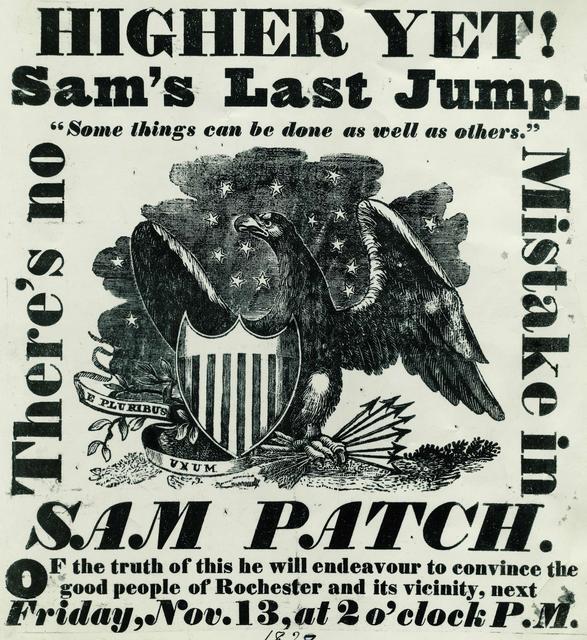
Patch had a special handbill printed for his second advertised jump: “Higher Yet! Sam’s Last Jump. “Some things can be done as well as others,” proclaimed the flyer. His last jump was announced for Friday, November 13 at 2:00 p.m.
Being determined to “astonish the natives” of the West before he returns to the Jerseys, he will have a scaffold twenty-five feet in height erected on the brink of the Genessee Falls, in this village from which he will fearlessly leap into the abyss below, a distance of one hundred and twenty-five feet.
Sam’s bear will make the same jump and follow his master, thus showing conclusively “that some things can be done as well as others.” Moreover, Sam hopes that all the good people who attend this astonishing exhibition, will contribute something towards remunerating him for the seemingly hazardous experiment.
The attendance to witness this last and highest leap on a chilly fall afternoon was estimated at 12,000 by the Colonial Advertiser. Parker notes that “he climbed up the pole to his platform hand over hand.”
His descent was so unlike that of the previous occasion, that almost everyone in the great concourse of horrified spectators was positive from the moment of his disappearance that he was dead. There was a look on the faces of those who turned away from the bank not easily forgotten. In less than five minutes almost everyone had fled from the locality, silent, sober, and melancholy.
Patch’s body was not discovered until the following March when a workman, seeking to water a team of horses, found the corpse after breaking through the thin, spring ice.
In the months before his body was found there were reported sightings of the famous jumper whose disappearance, they thought, was one last joke the Jersy Jumper had played. There was even a letter published in several newspapers where someone claiming to be Patch claimed, “You must know I performed my last jump by proxy, and died by proxy. It was a pleasant thing, too, to be a spectator to my own doings.” He claimed that a dummy, stuffed with straw, rags, and stone was his stand-in. “I was a bit afraid that the mock man would rise; but when the mob began to say, “Sam’s dead – he’s made his last jump – poor fellow.” It was more than I could well do to contain myself, it was such a capital joke.” The long letter is humorous, more reminiscent of Mark Twain, than the modest abilities of the Jersy Jumper.
Sam Patch’s body was buried in the Charlotte, New York Cemetery not far from the mouth of the Genessee river and, according to Johnson, marked with a simple unfinished board bearing the words “Sam Patch – Such is Fame.” A nearby boulder helped direct visitors to the Patch burial site. The rough board did not last long and for years a mark on a fence helped guide those seeking to pay homage to the famous jumper.
In 1911, John A. Copeland a Rochester resident petitioned the municipal governments of Charlotte and Rochester to fund a proposed monument to mark the grave of the celebrated showman, to no avail. One of America’s greatest celebrities remained, essentially, in an unmarked grave.
The next year Copeland and William Corry attached three metal bands to a nearby spruce tree to recognize the cemetery’s illustrious resident. The top band had the date of his last jump and demise“1929”, the middle band his name “Sam Patch,” and the bottom band the date of the memorialization “1912.” It looked the same in 1946, when high school student David Coapman found the grave, but a year later the tree blew down in a thunderstorm and Coapman’s fellow students from Charlotte High School retrieved the metal bands from the fallen tree, leaving only the boulder and the stump to guide visitors to the grave. Various efforts to mark the grave were unsuccessful, as recounted by David Coapman in the New York Folklore Quarterly (Spring 1949) until a local monument dealer offered to provide a traditional granite tombstone.
The monument was installed in July of 1948 with a formal dedication on November 12 before an audience of over fifty people. The front of the stone bears the inscription, “1807 Sam Patch 1829” On the back of the marker is a bronze tablet with this inscription: The grave of Sam Patch who leaped over the Upper Falls into the Genessee River at Rochester, N.Y. Friday Nov. 13, 1829. His remains were found in the lower Genessee River, March 17, 1830.”