


Milcah Bassel is fascinated by absence. Nevertheless, the objects she creates have true presence.
Her stoneware containers are worthless as amphorae: they’ve got square holes at either end. Anything liquid placed inside would drain right out. Yet the incapacity to retain matter does not necessarily make her “Vessels for Exchanging Emptiness” into voids. Title aside, these pieces are loaded. They’ve got hue, scent, weight, feel, and, most importantly, residue of the playful, offbeat personality of their sculptor.
They’ve also got their own peculiar relationship to their human admirers. They fit our grips like the handle of a hammer, or an avocado. Press your ear to one end, and you may even decide that they contain a particular ghostly hum.
And yes, you are encouraged to indulge in such personal interactions with these objects. At “Imaginal Cells,” a philosophically provocative solo show at the basement space formerly known as the NJCU Visual Arts Gallery (okay, okay, fine, it’s the Kean Jersey City Gallery now, and it’s at 100 Culver Ave.), you may pick these vessels up, look through the holes, press them to your cheek as you would the receiver of an old bakelite phone, or write your impressions of them in sleek logbooks provided by Bassel and curator Midori Yoshimoto.
You can, if you’d like, even take temporary possession of the void. For the low price of nothing, you can fill out a library card, bring emptiness home with you, and return it to the gallery in seven days.
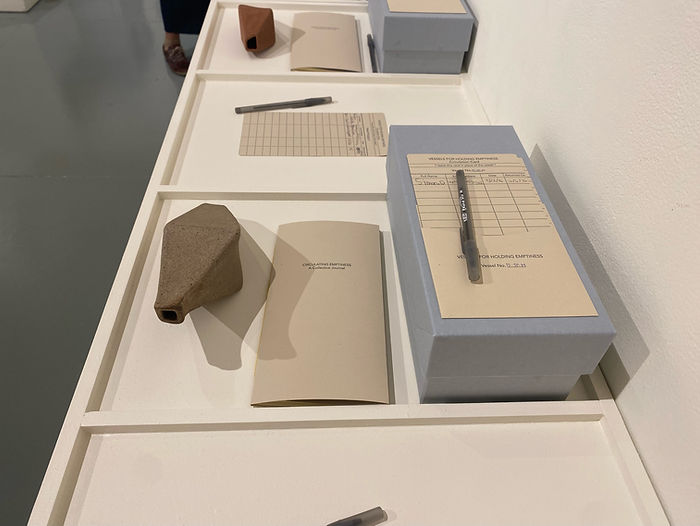
As every schoolkid knows, if you check something out of the library, you’re expected to take care of it. The artist has reframed emptiness as something to protect and perhaps even cherish.
By asking you to contemplate what these vessels lack as well as what they possess, Bassel has pulled off a neat conjurer’s trick. She’s managed to fill her negative space with significance. Absence, it turns out, is a tough thing to pinpoint or even locate. Even where there’s nothing, there’s always something.

And the boundaries around that something — the walls that define the empty area — help us organize our thinking about the things we observe. They tell us what we can possess and what is out of our reach. Intellectually, we know that the air inside the “Vessel for Hugging Emptiness” (really just a bigger version of the “Exchanging Emptiness” pieces) isn’t any different from that which circulates on the outside of its plaster parameters.
Yet the chamber within the piece feels numinous anyway. Stand at the right angle and you can see straight through it. But even as you’re gazing in one end and out the other, you’re conscious that your line of sight is passing through a shadowland. Since we can’t explore it in person, we’re told to throw our arms around the object that surrounds it, and cuddle it, as we might comfort a frightened poodle.

Not too long ago, Milcah Bassel puzzled visitors to the Evening Star Studio (11 Monitor St.) with a boardgame that arrived in the gallery with neither instructions nor outside guidance. We were invited to sit down and play anyway. If that meant we had to make up strategies on the spot, Bassel welcomed that; if, instead, we felt like moving the ceramic pieces around the central table in pure appreciation of their peculiar weight and feel, we could do that, too.
The artist was likely making a point about the way our minds work: how quickly we fill up blank spaces with rules and sub-ordinances in order to give our movements meaning and invest the emptiness of pure possibility with order and substance. Or maybe she just enjoyed setting us adrift. She wasn’t telling. Her poker face is one of her best assets.
There are things to play with at “Imaginal Cells,” too: not just the terra cotta vessels with their handsome surfaces, their smoothed apertures, and cool darkness within, but other objects to pick up and manipulate. One intriguing piece consists of more than twenty rectangular images, each about the size of a business card, attached to each other with strips of thick burgundy fabric. It’s possible to fold these together to create a single box, but the viewer must arrive at the proper sequence. Place the wrong plate down at the wrong time, and the artwork will resist, and refuse to cooperate.

Here, Bassel is entertaining us with the tactile joy of tucking, manipulating, and pressing one piece against another and the thrill of tidying up and fitting things into a small container. Then there’s the subversive fun that all kids who’ve played with a Transformer know well: the small object that contains a secret, sprawling larger object inside. Either way, this is a game of transfiguration — things becoming more than what they are — and it’s meaningful that each card in her connected deck contains a partial image of vessels stacked like spines.
The imprint of the body is everywhere in “Imaginal Cells,” including (especially?) in the places that are empty. Two years ago, Pop Nation learned what an imaginal disc was from Mica Tennenbaum of the great Los Angeles sci-fi synthesizer duo Magdalena Bay: a strata of cells and inchoate forms inside the larva of an insect undergoing transformation from one physical state to another. Technically, there is no butterfly visible inside the pupa, but something in that fuzzy, caterpillar-ish silence wants to be a butterfly, and that clutch of invisible cells is a roadmap through the darkness. In Bassel’s work, we feel bodily longing: a wish that we can be more than what we are, and that the silent voids we feel within ourselves could be staging areas for new forms.
Which brings us to Bassel’s “Continua” pieces. These are long, wide, lightweight blankets of three-dimensional shapes, each a bit like a sawed-off traffic cone, made from skin-like abacá paper and draped on the walls and floors of the gallery. One looks, and technically is, wearable. Another hangs on a hook like a side of meat from a butcher’s shop. “Blanket (Refuge),” the show’s truest spectacle, appears to pour out of one of the walls and puddle and pool on a trio of platforms. The artist has stained her amalgamations of shapes with earth tones and given them contours that imply musculature. They’re the rare works of art that appear to be lab-grown. They are fascinating to circle around, but intimidating to approach.

They are also never disorderly. All of the adjoining pieces are roughly the same shape. Because they’re handmade, they don’t look like copies of each other. Instead, they suggest the mutations and natural variations that occur when a cell replicates. The “Continua” sculptures do not seem to respirate, and they don’t seem asleep, either. But in their repose, they appear to be gathering possibilities. They rest and dream in a netherworld somewhere between the organic and the sessile. What imaginal disc underpins them and might, when the time is right, spur them toward action?
“Spillage/Diver” a large work on paper, approaches the same question from a slightly different angle. Milcah Bassel has cut quadrilaterals of different dimensions out of a ledger, tinted them black, hot pink, and entrail crimson, and assembled them into a great crosshatched sheet. (Ever the right-angled rationalist, Bassel adores quadrilaterals.) By varying the width and color of her hundreds of pieces, she directs the eye as a good mosaicist might: from the top of the tapestry to its bottom left corner. There, a human shape appears to land on the floor in a splatter of amniotic fluid.

Though all the lines in the piece are straight, they’re staggered and slanted sufficiently to make the image bulge, as if it’s about to burst open, give up its secrets, and share its freight. Curator Yoshimoto told me that Bassel wasn’t intending to represent a body in the COVID-haunted days when she began making the “Spillage/Diver.” That’s the funny thing about the imaginal cell, and about imagination itself. It’s not always triggered by active thought. One day, the chrysalis opens.
(“Imaginal Cells” is on view in the Visual Arts Gallery until November 24. The handover from NJCU to Kean appears to have changed very little, but if you know me, I’m sure you know exactly why it hurts my heart. Anyway, the show is open on weekdays from noon until 5 p.m.)


Tris McCall regularly writes about visual art (and other topics) for NJArts.net, Jersey City Times, and other independent publications. He's also written for the Newark Star-Ledger, Jersey Beat, the Jersey City Reporter, the Jersey Journal, the Jersey City Independent, Inside Jersey, and New Jersey dot com. He also writes about things that have no relevance to New Jersey. Not today, though.
Eye Level is an online journal dedicated to visual art in Jersey City, New Jersey. A new review will appear every Tuesday morning at 8 a.m., and there'll be intermittent commentaries posted to the site in between those reviews.
Eye Level is made possible by an Andy Warhol Arts Writers Grant.



There are multiple performances including:
Wednesday, October 14, 2026
@ 7:30pm
McCarter Theatre Center (Matthews Theatre)
Princeton, NJ

There are multiple performances including:
Wednesday, October 14, 2026
@ 7:30pm
New Brunswick Performing Arts Center (NBPAC)
New Brunswick, NJ

There are multiple performances including:
Wednesday, October 14, 2026
@ 7:30pm
Kean Stage - Bauer Boucher Theatre Center
Union, NJ

Thursday, October 15, 2026
@ 7:00pm
Union County Performing Arts Center (UCPAC) - Main Stage
Rahway, NJ

Thursday, October 15, 2026
@ 8:00pm
Mayo Performing Arts Center
Morristown, NJ