

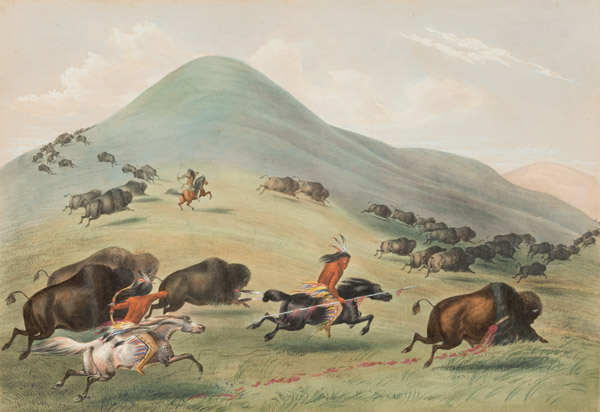
George Catlin (1796-1872) Buffalo Hunt, Chase, 1844, plate 6 from Catlin’s North American Indian Portfolio Hand-colored lithograph by John McGahey (British, 1817? -1855), 18 1⁄2 x 23 1⁄2 in. (sheet), Gift of Ruth Bannister in memory of Lemuel Bannister, 1981.23.6
(MONTCLAIR, NJ) -- The Montclair Art Museum (MAM) presents Shifting Terrain: Perspectives on Land in North America, a major exhibition drawn from the Museum's permanent collection that reexamines nearly two centuries of American and Native American art through the lens of land, identity, and history. Curated by Chief Curator Gail Stavitsky with the assistance of Laura J. Allen, Curator of Native American Art, the exhibition opens on April 25, 2026 and will be on view through April 2028.
Reframing the American Landscape - Conceived in response to the United States' upcoming 250th anniversary, Shifting Terrain asks how a museum can reflect on American ideals while also confronting the histories of dispossession, enslavement, expansion, and environmental degradation that are embedded in the land itself. Spanning works from the early nineteenth century to the present, the exhibition explores land as a physical place, political site, spiritual force, and living entity.
The title reflects multiple, interlocking meanings: terrain as physical landscape, as metaphor for personal, cultural, and political territory, and as an idea that is perpetually in motion. The exhibition's geographic scope extends beyond the United States to North America, recognizing that the boundaries that define national identity are themselves contested, particularly through the lens of Indigenous experience.
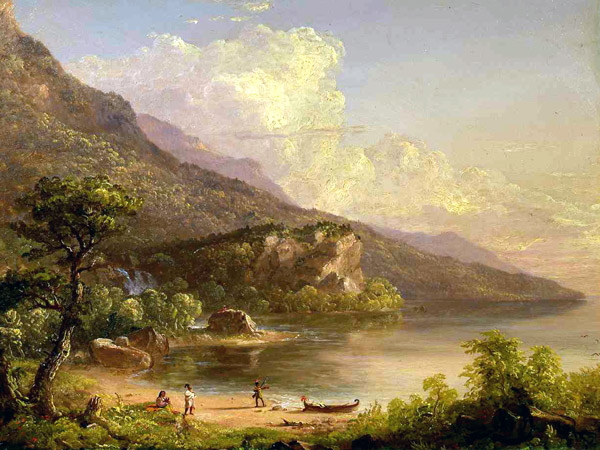
Thomas Cole (1801-1848), A View of the Hudson, ca. 1835, oil on wood, 13 x 17 1⁄2 in., Gift of Mr. And Mrs. Carl H. Schlachter, 1964.57
"The Declaration of Independence promised equality, life, liberty, and the pursuit of happiness for everyone -- yet those promises remain aspirational," said Stavitsky. "This exhibition wrestles with how we honor those unfulfilled ideals while honestly acknowledging the complex, difficult histories bound up in the land itself."
Where Past and Present Meet - The exhibition places historical, modern, and contemporary works in deliberate visual dialogue. Land, Spirit, Power (2017) by Jeffrey Gibson (Mississippi Choctaw/Cherokee) anchors the title wall alongside nineteenth-century landscapes -- including the romanticized Hudson River vistas of Thomas Cole and Asher B. Durand -- works that functioned not merely as aesthetic achievements but as documents of imperial ambition.
Stavitsky draws particular attention to how figures of Indigenous people in stereotyped dress appear as symbols in Cole's panoramas, their presence reflecting the era's narrative of a "vanishing wilderness." Historical and modern Native artworks selected by Allen -- including a pair of well-worn Eastern Woodlands moccasins, a Pueblo water jar, and a Cherokee basket -- are integrated in the installation to complicate familiar images of American land from the past through ongoing Indigenous presence and perspectives.
What Visitors Will Encounter - Shifting Terrain brings together works by Thomas Cole, Raven Chacon, George Catlin, Carrie Mae Weems, Julian Martinez, Edward Hopper, Arthur Dove, Marsden Hartley, Kara Walker, George Inness, Robert von Sternberg, and many others. It also includes important rediscoveries from MAM's holdings: Asher B. Durand's monumental Early Morning at Cold Spring (1850), unseen at the Museum for more than a decade; a previously unexhibited Currier & Ives print, Rocky Mountains, Emigrants Crossing the Plains (1866); and nineteenth-century survey photographs of Western scenes by Andrew Russell and William Henry Jackson alongside a related Baje Whitethorne, Sr. (Diné) watercolor, returning to view after extended absence.
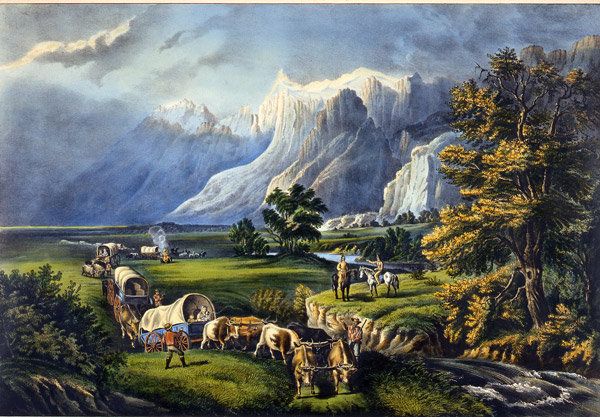
Frances Flora Bond Palmer (1812-1876), The Rocky Mountains (Emigrants Crossing the Plains), 1866, hand-colored lithograph published by Currier & Ives, sheet: 24 1/4 x 31 7/8 in., Gift of Emily P. Ridgway in memory of J. Lester Parsons, 1985.123
Additional works and recent collection highlights broaden the exhibition's scope across North America, including Rafael Ferrer's Estudio Tropical (ca. 1985); the mixed-media Modern Warrior Series: War Shirt #3 by Bently Spang (Tsitsistas/Suhtai [Northern Cheyenne Tribe]) (2006); 1970s land and environmental art by Athena Tacha and Dennis Oppenheim; Tiguex (2025), a promised gift work by Raven Chacon (Diné); as well as a Jacob Lawrence landscape print from the abolitionist series The Legend of John Brown (1977), not shown in many years.
More Than a Landscape Show - While the exhibition confronts difficult histories -- including Indigenous dispossession, westward expansion, enslavement, and conservation's complicated legacy (including the founding of the National Park System, which displaced Indigenous communities from ancestral lands) -- it also presents artists who have approached nature as a source of personal and spiritual renewal. Beyond Indigenous artists in this regard, for the late nineteenth-century landscape painter George Inness and early modernists such as Arthur Dove and Marsden Hartley, land became a vehicle for artistic freedom, inner expression, and new ways of seeing.
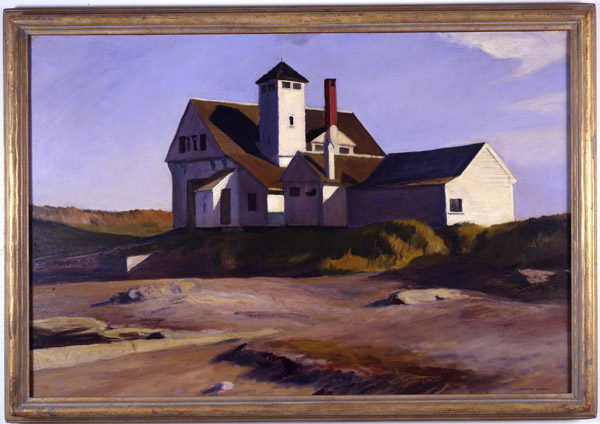
Edward Hopper (1882-1967), Coast Guard Station, 1929, oil on canvas, 29 x 43 in., Museum purchase; Picture Buying Fund, 1937.21
The exhibition also includes Edward Hopper's Coast Guard Station (1929), painted along the rocky coast of Maine at Two Lights, when he spent the summer at Cape Elizabeth. Hopper developed a unique and sometimes haunting vision of the American landscape and the human condition.
Shaped Through Two Curatorial Lenses - Allen's collaboration and expertise was integral to the exhibition's development. She consulted with Indigenous artists and knowledge-keepers, authored labels for Indigenous works in the show, and helped shape its treatment of Indigenous sovereignty, land rights, and representation. Stavitsky also consulted directly with living non-Native artists represented in the exhibition to ensure their perspectives were accurately reflected.
Built for Conversation and Return Visits - With its extended run through April 2028, Shifting Terrain is designed for sustained public engagement, inviting repeat visits and deepening conversations around North American history, Native cultures, conservation, and changing ideas of land and stewardship. MAM is developing tours, talks, and related programs in connection with the exhibition -- including school and educator partnerships.
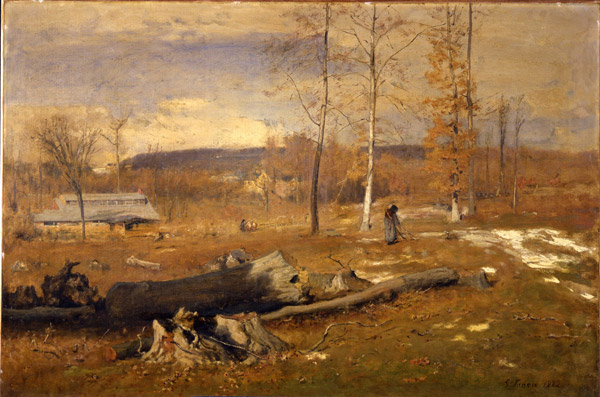
George Inness (1825-1894), Winter Morning, Montclair, 1882, oil on canvas, 36 1⁄2 x 50 1⁄2 in. (framed), Gift of Mrs. Arthur D. Whiteside, 1961.1
"People might come to the show with some preconceived idea of what land and nature means," said Stavitsky. "My hope is that this exhibition complicates and enriches those perspectives -- that people leave thinking differently about American history, about the Declaration of Independence, and about what it means to be American."
The Montclair Art Museum (MAM) champions American and Native American art€”past and present. Through bold exhibitions, hands-on programs, and deep community ties, MAM sparks creativity, connection, and conversation. Guided by its core values of respect, collaboration, education, and inclusion, the Museum is a vibrant hub where art meets ideas, and everyone is invited.
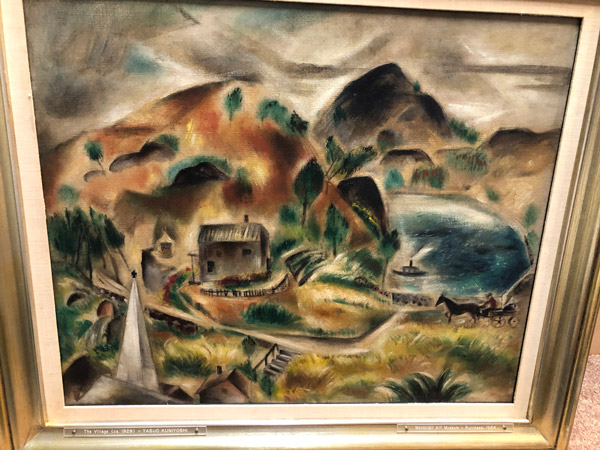
Yasuo Kuniyoshi (1889-1953), The Village, ca. 1921-29, oil on canvas, 20 1⁄4 x 24 1⁄4 in., Museum purchase; Lang and Members Acquisition Funds, 1964.85