
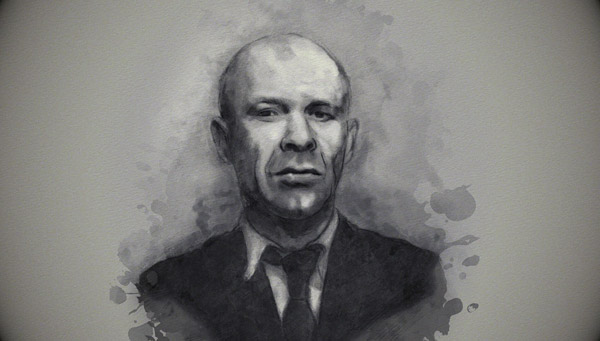
The Shoshani Riddle is a true international movie. Opening his investigation in France, director Michael Grynszpan traveled the globe from Israel to Uruguay, tracking the life of the mysterious Mr. Shoshani. Overdubbing a dramatized animation of Shoshani walking the streets of 1950s France, the film introduces its mysterious star. Shoshani was a great scholar and nomad throughout the mid 20th century. It was reported he spoke over 30 languages and had a perfect memory of the Torah, Talmud, Tanakh, and more. Earning the nickname “The Jewish Socrates,” Shoshani was a figure devoted to inquiry yet steeped in mystery. On his grave it is written, “His birth and his life are sealed in enigma.” While most audiences might be unfamiliar with Shoshani, his students include Nobel Laureate Elie Wiesel, who authored the mysterious epitaph of Shoshani’s tombstone.
The medieval Jewish philosopher Maimonides believed truly great thinkers speak in riddles and analogies. Thus, in solving the riddle of Shoshani's life, filmmaker Michael Grynszpan enters into a pseudo-dialogue with the deceased genius.
In his search to discover the truths of Shoshani, Grynszpan interviewed countless individuals claiming to have interacted with Shoshani. Grynspan begins in a french orphanage, where Shoshani and Elie Wiesel first met as traveling lecturers. Wiesel wrote, reflecting on his first time meeting Shoshani, “My days of lecturing were over and I became a pupil again.” As Grynszpan continues his interview with the orphanage’s former director, the realities of 20th century Europe set in. A photo irrelevant to the Shoshani mystery is held up. In it, a dying orphan boy, left with no one but the orphanage’s director to mourn him after his entire family had been killed in the Holocaust. Though not the main focus, like many inquiries of Jewish figures from the 19th century, the grim shadow of the Holocaust rests hauntingly on the film's periphery.
As Grynszpan furthers his investigation to pin down the facts of Shoshani’s life, he records countless stories. In interview after interview, two things are repeated again and again, the great genius of Mr. Shoshani and his ragged, bummish appearance.
One such story speaks of a Talmudic studies class Shoshani taught in prewar France. The class was suspended in 1940 due to the war. When it resumed in 1945, Shoshani quickly reminded the class where they had left off and resumed with the same page and paragraph from five years, and a lifetime, ago. However, interviewees also claim Shoshani’s intellect expanded far beyond religious studies and into math and science.
While praise of his intellect is universal, the finer details of Shoshani’s remained confused. Interviews contradict themselves, and Shoshani seems silent, obscured by his larger than life myth. As Grynszpan becomes increasingly overwhelmed, the walls of his office fill with pictures, like a detective mapping his way to the center of the Shoshani riddle.
Told by many that he should give up, Grynszpan reaches a pivotal point when decides to push for a meeting with Elie Wiesel. In an effort that would be the dramatic midpoint of any Hollywood film, Grynszpan manages to catch Wiesel’s attention and is given an interview. Wiesel's words reignites Grynszpan’s determination, saving the investigation from becoming a scraped documentary.
Tracking Grynszpan’s documentary quest, the film explores how his investigation shifts from discovering the cold hard details to understanding Shoshani’s intentions. The film shifts from mapping the mystery to understanding the importance of it and as a result Shoshani comes alive in a way Grynszpan never expected.
As Grynszpan uncovers more and more information, the film takes an unexpected turn, encountering a secret society and uncovering a treasure trove of writing that not only reveals the original question of Shoshani’s name and birthplace, but also Shoshani’s message. In the end, a film that was intended as a simple inquiry stretched ten years and led to the uncovering of countless volumes of notebooks important to Judaism, philosophy, and the world at large.
The Shoshani Riddle screens at the New Jersey Film Festival on Sunday, February 1, 2026 – Online for 24 Hours on this date and In-Person at 5PM in Voorhees Hall #105/Rutgers University, 71 Hamilton Street, New Brunswick, NJ 08901! Get more info and buy tickets here.
The 44th Bi-Annual New Jersey Film Festival will be taking place on select Fridays, Saturdays, and Sundays between January 23-February 22, 2026. The Festival will be a hybrid one as we will be presenting it online as well as doing in-person screenings at Rutgers University. Most of the films will be available virtually via Video on Demand for 24 hours on their show date. VOD start times are at 12 Midnight Eastern USA. Each General Admission Ticket or Festival Pass purchased is good for both the virtual and the in-person when both are offered. The in-person screenings will be held in Voorhees Hall #105/Rutgers University, 71 Hamilton Street, New Brunswick, NJ beginning at 5PM or 7PM on their show date. General Admission Ticket=$15 Per Program; Festival All Access Pass=$120; In-Person Only Student Ticket=$10 Per Program. For more info on the Film festival go here: https://newjerseyfilmfestivalspring2026.eventive.org/welcome