

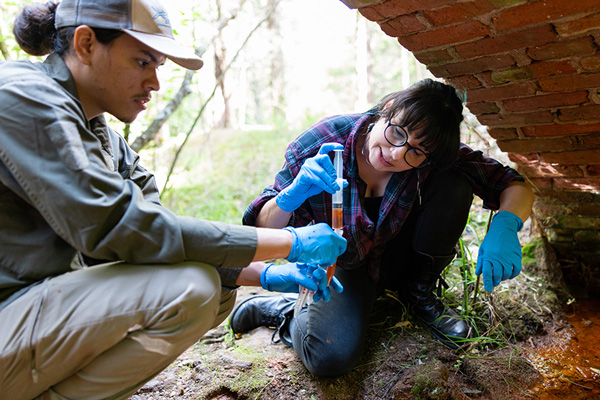
Left, Juan Diego Chaparro Villarreal, a 2025 Stockton alum, works with Lauren Seyler, assistant professor of Biology, to take an iron-rich sample from the water at the Harrisville bog iron site. Photo by Susan Allen/Stockton University
(CHATSWORTH, NJ) -- As she hiked through the woods toward the research site deep in the Pine Barrens, Jesse Davis wondered what she had gotten herself into.
The Stockton University Biology major spent the past few minutes traipsing through the woods, dodging ticks, mosquitos and frequent poison ivy plants to Harrisville, the site of a now-abandoned bog iron furnace during the Revolutionary War.
But Davis wasn’t there to marvel at the stone ruins that produced cannonballs and railroad ties in the past. She was more interested in “the pond gunk” growing at the site in the present.
The Lacey Township native and Stockton senior is part of a group working with Assistant Professor of Biology Lauren Seyler to study microbial growth at groundwater seeps in the Pine Barrens, specifically ones that produce iron.
In 2024, Seyler received a three-year, $500,000 grant from the National Science Foundation to study three bog iron sites in the Pine Barrens where huge collections of bacteria grow that either use iron as an energy source or respire it in the same way humans do oxygen.
“Without being involved with this project, I wouldn’t have learned about this niche community of bacteria. I would have just assumed it was gunk in the swamp,” Davis said. “I didn’t know that living things could respire iron.”
Seyler is also fascinated by these tiny microbes not only for what they do on this planet, but what they might do on others, like iron-rich Mars, for example.
“Iron is vital to life. It’s the most abundant element on the planet. There are no organisms on the planet that don’t need iron in some form,” the astrobiologist said, adding that humans need iron in our diet because it’s in the hemoglobin in our blood that binds to the oxygen that is then carried throughout our bodies. “Understanding these iron-driven metabolisms may be important for understanding how life operates on this planet, how it started on this planet and how to look for it on other planets.”
The grant is part of an NSF program that aims to increase research capacity and broaden participation in the biological sciences at institutions, like Stockton, that primarily focus on undergraduate education.
“We don’t have access to some of the equipment and the person hours that some of these larger institutions have. The grant is designed to provide money for equipment and supplies, and to support faculty and student salaries,” Seyler said. “It’s this kind of scientific research at the undergraduate level that makes Stockton really unique compared to other larger schools.”
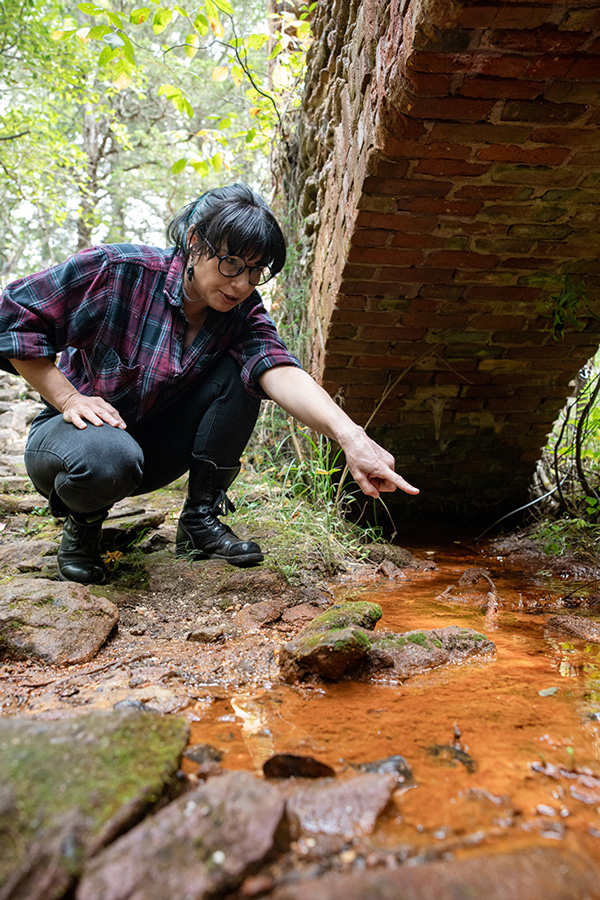
Lauren Seyler, assistant professor of Biology, points out some of the iron-rich microbes found in the water at the Harrisville site. Photo by Susan Allen/Stockton University
Seyler said the grant allowed her to pay three students and a recent alum to do summer research and, as part of the university’s Live-Work-Learn program, live for free on campus.
“I live in Freehold, and I couldn’t reasonably come down here and go back every single day. So being able to live on the Galloway campus was great,” said Jasper Herbert, a senior who is part of the four-person team working with Seyler.
The biochemistry and molecular biology major spent the summer getting his first taste of lab work by doing a lot of DNA and RNA extractions from the hundreds of biomass samples taken from bog iron sites at Harrisonville, Batsto and Weymouth Furnace in Mays Landing.
“I didn’t even know this was something that undergraduate students could do,” he said. “And it’s not a watered-down approach to molecular biology. I’m doing the same things in this lab that professionals get to do and write academic papers about. So, it’s a really unique experience. I’m water sampling where people 300 years ago got their drinking water.
“And because Stockton is a smaller school, I don’t have to fight hundreds of other people for the position. It’s really accessible to me, and I really appreciate that.”
As part of the excursion to Harrisonville, Herbert and Davis worked with Seyler and recent Stockton graduate Juan Diego Chaparro Villarreal to collect about 70 samples of water and sediment from the brightly colored microbial mats growing near the bog iron plant ruins. The microbes take the dissolved iron in the water and turn it into a mineral that was collected and refined to make cast iron pots, cannonballs and railroad ties during the Revolutionary War, Seyler said.
“The iron industry is important to the history and the founding of this country. So, this is a really cool tie-in between history and biology,” she said. “It’s part of what makes the Pine Barrens so unique is that we have this really interesting acidic, iron-rich water and this process is not very well understood. I saw this void in our understanding of this really important process in the Pine Barrens.”
For Villarreal, the grant allowed him to be hired as a temporary employee and has given him an opportunity to teach undergraduate students how to do research.
“My job, primarily, is to make sure the students get opportunities and experiences. Make sure they don’t mess up the samples and they are following proper protocol,” he said. “Make sure they know how to observe and understand what they are doing and keep everything as sterile as possible.”
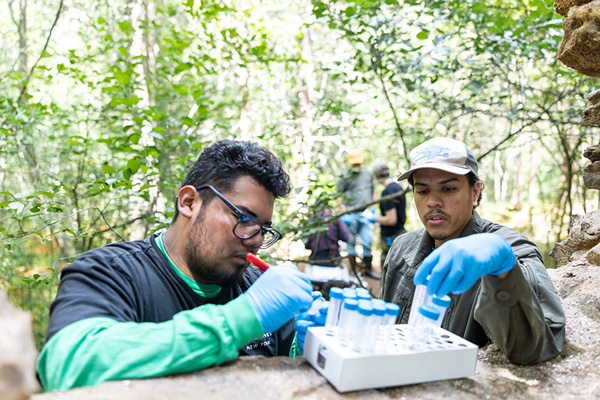
Left, Stockton student Edwin Feria-Serna works with Juan Diego Chaparro Villarreal to label a sample of bacteria taken in Harrisville in the middle of the Pine Barrens during a field trip in late August. Harrisville is one of three sites, including Batsto and Weymouth Furnace, where microbes are being sampled as part of a $500,000 National Science Foundation grant. Photo by Susan Allen/Stockton University
He considers doing field work “a privilege,” especially since he grew up in Hudson County, far from the Pine Barrens.
“It’s very, very different from where I grew up. There’s not much nature where I lived,” Villarreal said. “Working on this grant is such a bridge between history and culture and nature. We want to provide a new piece of New Jersey history, even though it’s a microscopic one.”
Stockton University is ranked among the top public universities in the nation. Their nearly 9,000 students can choose to live and learn on the 1,600-acre wooded main campus in the Pinelands National Reserve in South Jersey and at their coastal residential campus just steps from the beach and Boardwalk in Atlantic City. The university offers more than 160 undergraduate and graduate programs.