

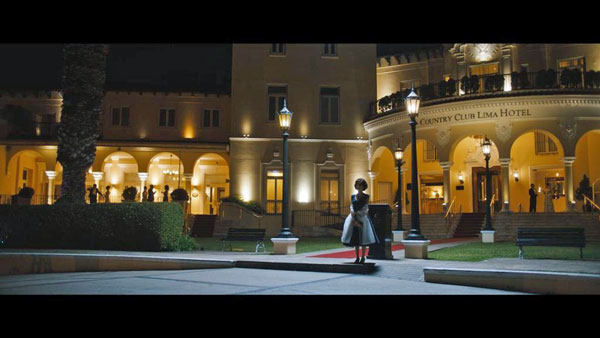
Sometimes losing everything is the start of something new. In Mistura, director Ricardo de Montreuil tells the story of a woman in 1965 Lima, Peru, whose comfortable life falls apart and who begins to rediscover her country through food and the people around her.
The film centers on Norma (Barbara Mori), a French Peruvian woman from Lima’s upper class. When her husband leaves her on New Year’s for another woman, she is pushed out of the elite circles she once moved in. In a time when women of her class were expected to focus only on the home and appearances, she suddenly finds herself without support. With no work experience and a large house to manage, Norma must find a way forward. This necessity brings her into the kitchen and into contact with people she had long overlooked. What begins as survival gradually becomes something more when she decides to build her own future.
Norma’s decision to open a restaurant begins as a matter of survival but evolves into something more profound. While initially hesitant, food becomes a way of bridging the barriers that had long divided her from the people around her. What begins as a practical solution gradually grows into something more meaningful, as the dishes and flavors she embraces reveal parts of the country she had never experienced before. The connection emerges naturally through the process of cooking and sharing food.
The title Mistura, meaning mixture, captures the essence of the film. Peru itself is a mixture, and the food reflects that history. Dishes carry the legacies of African, Chinese, Japanese, and Spanish colonial influences blended with Indigenous heritage. By placing food at the center of Norma’s journey, the film shows how food reflects the layers of Peru’s history and identity. As a Peruvian-American, I found this perspective meaningful. I may not have grown up in Lima of the 1960s, but I understand how food carries history across generations. The film clarifies that Peru’s identity is inseparable from its diversity, and it was striking to see that captured through such an intimate story.
De Montreuil and his team worked with a historian to recreate 1965 Lima, Peru, with care, from language and gestures to wardrobe and hairstyles, and that attention to detail grounds the film in its period while allowing the themes to feel timeless. The cinematography is beautiful and captures Lima in a way that feels effortless. It supports the film’s pacing and is a quiet expression of Norma’s journey. The music mirrors this approach, blending Afro-Peruvian rhythms with classical arrangements to create an atmosphere that feels true to its time. The sound and imagery together create a world of depth, where every detail reinforces Norma’s transformation.
Oscar, Norma’s chauffeur, is one of the film’s most memorable characters. His calm wisdom provides another vision of Lima, one rooted in community and resilience rather than status. Through her relationship with him and with others, Norma learns that the people she once overlooked are the ones who reshape her life. The 1960s backdrop sharpens Norma’s transformation. Class lines were strict, and women had limited choices. Her growth comes from stepping beyond society’s expectations and finding her own way. Visually, the cool tones of her old life shift to warmer colors as she embraces change. By the end, her restaurant celebrates Peru’s mixture and her own renewed sense of self.
Mistura is a grounded and engaging film about culture and connection. It shows how food can carry history and bring people together across divides. It also felt personal, giving me pride in my heritage and a deeper appreciation for the diversity that shapes Peru.
Mistura will be screening at the Fall 2025 New Jersey Film Festival on Friday, September 12. The film will be Online for 24 Hours on this show date and In-Person at 7 PM in Voorhees Hall #105/Rutgers University, 71 Hamilton Street, New Brunswick, NJ. Tickets are available for purchase here.
The 44th Bi-Annual New Jersey Film Festival will be taking place between September 5-October 10, 2025. The Festival will be a hybrid as we will be presenting it online as well as doing select in-person screenings at Rutgers University. All the films will be available virtually via Video on Demand for 24 hours on their show date. VoD start times are at 12 Midnight Eastern USA. Each General Admission Ticket or Festival Pass purchased is good for both the virtual and the in-person screenings. Plus, we are very proud to announce that acclaimed band Cold Weather Company will be doing an audio-visual concert on Friday, October 10 at 7PM. Lastly, we will be offering three FREE Filmmaking Workshops! The in-person screenings and the Cold Weather Company concert will be held in Voorhees Hall #105/Rutgers University, 71 Hamilton Street, New Brunswick, NJ beginning at 1PM, 5PM or 7PM on their show date. General Admission Ticket=$15 Per Program; Festival All Access Pass=$120; In-Person Only Student Ticket=$10 Per Program. The Filmmaking Workshops are FREE and open to the public but have limited seating and require advance registration. To register email us at [email protected]
For more info go here: https://newjerseyfilmfestivalfall2025.eventive.org/welcome