
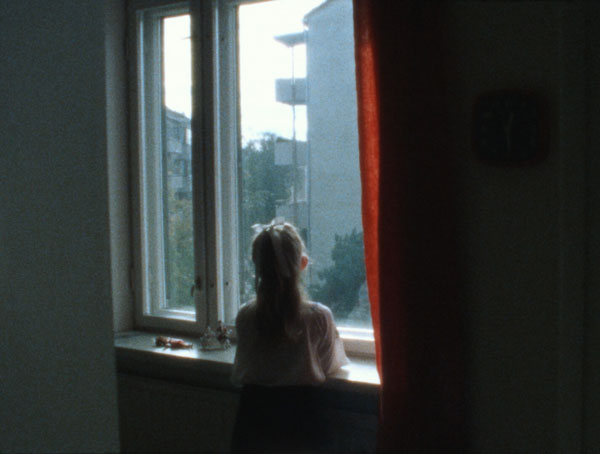
In her intro for the New Jersey International Film Festival, director and scriptwriter Camilla Roos describes her new documentary Child No. 182, Barn nr 182 in Finnish and confirms that it is based on her own childhood. Child No. 182 follows Roos from her birth to her 8th year of life, as she was circulated through the foster and orphanage system in the 60s and 70s of Finland. The task of visualizing this past personal experience, and its wider implications for child protection, centers in archival print, photography & footage, and 8mm film shot by Roos’ team. The archival material includes municipal documents, letters and reports from social workers, as well as photos of Roos and guardians.
Standard footage of children, like babies crying in a joint hospital crib, in rows of cribs, or being fed by nondescript nurses, become infused with new meaning in the context of Roos’ story. As a baby, Roos is given her number: 182. The audience is folded into her perspective pondering a youth made uncertain. The story grows as she tells it.
From the first cinematic beats to the final, Roos pictures herself leafing through photo albums, sifting through papers. When did the director first do this? Was the beginning of this journey initiated for the film, or when did its capturing come into it? How did the film change the search itself? The director is portrayed in suspension as her narrative is built. Her unveiling of the past was a slow process, she describes, over a shot of herself hanging a man’s naval suit, then a woman’s and girl’s dresses, in thoughtful order. The visual of the director handling physical materials like paper and fabric reminds the viewer of the deeply personal nature of this search for truth—the inseparability of the wishes, hopes, visions, and fears of Child No. 182 in understanding why her situation came to be.
The rhythm of the audio—narration, recitation, piano—with nostalgic frames of growing kids creates a tension: the quivering question of what really weighs as the truth in an unvouched-for childhood. It leaves the viewer with more questions about the foster experience and how to fix it. Roos gives us her own unanswered questions to grasp, forever unmoored threads of wondering. The cold fact of external official statements only adds layers: the mother’s health, physical and mental, the father’s tendency to drink. An orphaned state is redefined as Roos becomes another case in the child welfare office. This alternation of sound creates a cadence like waves: a voice soft and personal, meandering, to one short and direct, clinical but not unkind, to music gentle and inquisitive. The audience learns to take on these different views of the same Pandora’s box, adopting different kinds of listening.
The biological parents are never villainized, as challenged by the soft narration of the child, now adult, No. 182. Roos doesn’t want to harbor the bitterness her mother had towards her husband, Roos’ father. Her questions give him the benefit of the doubt, and remind us we all crave the warmth of a parent’s love—and the fondness of a well-preserved childhood.
The piecing together of her mother’s own foster experience is pictured in a collage of old photos—a grandmother, and grandfather, with penciled captions, and verbal one-sentence descriptions of their stories. The passing down of a foster mother from mother to daughter. The various medications the mother was prescribed. In this way, Roos demonstrates the detached nature of the bits of insight she accumulates about her family history, and her childhood. Similarly, she strings together footage ephemerally.
The use of film creates a dreamy quality, with various young girls, pictured alone or with adults, facilitating the imagination of the audience members. By including images of many young girls Roos expands the experience to include generations of orphaned children in the piecing together of her own complex instance of it. The sheer joy of childhood seeps through it all, as we observe real children playing or existing. Yet, the simplicity of acts like sitting and drawing at a table, putting on shoes, looking at the camera, is weighed with sadness.
Roos’ lens on the foster child experience is unique, constructed in an emotionally compelling form that evokes compassion in the viewer. The perspective of the now grown up child looking back through her complicated and shadowy history creates a natural intrigue and pang in the hearts of the listeners.
Beautifully done, sensitively executed, and offered with nuance to the viewer - the film is a wonderful narrative representation of childhood without stable parenthood, and the director’s experience of it.
Child No. 182 screens at the 2025 New Jersey International Film Festival on Thursday, June 5th. The film will be Online for 24 Hours. Tickets are available for purchase here.
The 30th annual New Jersey International Film Festival will be taking place between May 30-June 13, 2025. The Festival will be a hybrid one as we will be presenting it online as well as doing select in-person screenings at Rutgers University. All the films will be available virtually via Video on Demand for 24 hours on their show date. VOD start times are at 12 Midnight Eastern USA. Each General Admission Ticket or Festival Pass purchased is good for both the virtual and the in-person when both are offered. Plus, we are very proud to announce that acclaimed singer-songwriter Mike Kovacs will be doing an audio-visual concert on Friday, June 13 at 7PM! The in-person screenings and the Mike Kovacs concert will be held in Voorhees Hall #105/Rutgers University, 71 Hamilton Street, New Brunswick, NJ beginning at 5PM or 7PM on their show date. General Admission Ticket=$15 Per Program; Festival All Access Pass=$120; In-Person Only Student Ticket=$10 Per Program.
For more info go here: https://2025newjerseyinternationalfilmfestival.eventive.org/welcome