

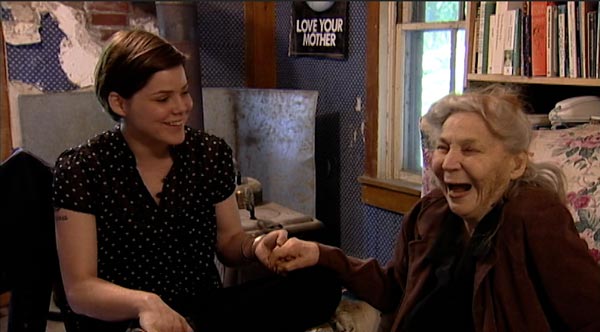
Great documentaries bring to light stories of people or events worth knowing about. Often they point a spotlight on a subject not very familiar to you. Ruth Stone's Vast Library of the Female Mind is one such documentary. The film by Nora Jacobson tells the story of Ruth Stone, a woman who was a promising young poet, living an idyllic life with her beloved husband, Walter, a poet and professor. When he died unexpectedly by suicide, Ruth was flung out into the world, destitute with three daughters to support.
Though not well known outside of the poetry world, Ruth won accolades and awards, such the National Book Award for Poetry, the Wallace Stevens Award, the National Book Critics Circle Award, two Guggenheim Fellowships, the Delmore Schwartz Award, and she was a finalist for the 2009 Pulitzer Prize for Poetry, among many others.
Beloved by many, Ruth’s house in Goshen, Vermont became a mecca for students, poets, friends and family members. There she inspired people to make art and write, not only through activities such as the “poetry game”, but by providing solace and nurture, surrounded by nature and camaraderie. After Ruth died, her granddaughter Bianca Stone and husband Ben Pease, began renovating Ruth’s house and turning it into a writer’s retreat. Their goal is to create an enduring legacy that will keep Ruth’s name alive and nurture a new generation of poets.
As luck would have it, Jacobson knew there was good footage of Ruth because she was hired to film interviews done by Chard deNiord. She wound up piecing together a wonderful documentary with footage from those interviews, a film by Sidney Wolinsky, various live performances from the years, and new footage of Ruth's family and the writer's retreat in action. The end result tells Ruth's story in a very interesting way.
Ruth Stone's Vast Library of the Female Mind will be screened at the New Jersey Film Festival on Saturday, January 29th as part of the festival's opening weekend. The film will be available virtually via Video on Demand for 24 hours on their show date. Tickets are $15 per program, or $100 for Festival All Access Pass.
New Jersey Stage reached out to Nora Jacobson to learn more about the film.
You were working for Chard deNiord when you first met Ruth Stone. Were you a fan of her poetry at the time? Did you know much about her?
I received a phone call from a poet named Chard DeNiord sometime in early 2007. A mutual friend had recommended me to shoot an interview with a poet. Despite the fact that both my parents were writers, the name Ruth Stone was not familiar to us. I should say that at the time I did not read any poetry and spent all of my time making films, (which I still do, but also now read poetry!)
But I am always interested in filming and meeting interesting people, and it was a paid gig, so I said “sure!” We made a plan to meet at Ruth’s daughter’s Marcia’s home in Ripton, Vermont. Ruth was living there at the time. She was already quite elderly (94). I was intrigued and fascinated as soon as I met her. I returned to film Ruth’s 94th birthday party and met Ruth’s granddaughters Bianca, Hillery and Nora and her daughter Marcia. Then I met daughter Phoebe and began thinking about making an actual documentary of Ruth’s life. I began raising money from the Vermont Arts Council and other places.
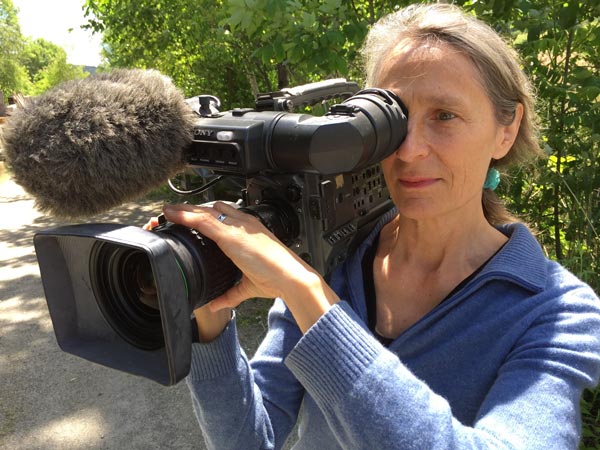
Your company website says you spent 12 years working on this film. When did the idea first come to you to gather the old interview footage and tell Ruth's story?
I safeguarded that initial footage, determined to expand on it and make a film, but I was involved in several other projects, a feature film called The Hanji Box, and a 6-part documentary about Vermont, Freedom & Unity: The Vermont Movie. It was only in 2014 that I had enough time to return to the footage of Ruth and begin thinking about how it could be made into a film. My challenge was to make a film about a person whose medium is words. I worried it might not be cinematic, despite Ruth’s wonderful presence on camera. I began thinking about ways to make it visual.
Chard had told me that Sidney Wolinsky (now a well-known Hollywood editor) had filmed Ruth in 1973 for a short film he was making as his thesis film in graduate school. I contacted Sidney who offered me all of the 16mm outtakes of that short film (The Excuse). I drove to Santa Monica, CA, and Sidney took me into the garage where all of the old footage and audio tapes were stored (some of the film was rotting–you can actually see some of that degraded footage in the film, though much of it was pristine). The Vermont Archive Movie project and the Vermont Folklife Center paid to digitize all of the footage and audio. A couple of Dartmouth students helped synch up the footage to the sound, and I was able to incorporate it into the film.
I loved how you presented the film across several time periods rather than chronologically. Did you do that because it made a more interesting storyline or was the idea to simulate a piece of poetry? For me, it felt like the latter - a poem that tells a complete story, but does not follow a linear path.
I love your comment of the film feeling like a poem itself. I did not do that intentionally. But I have always felt that the past contains the seeds for the future. The present holds the traces of the past. So in Ruth’s beautiful 94-year old face, you see the different kind of beauty of the younger Ruth. Her voice has changed as well, but you can hear the young Ruth in the old Ruth's voice. We are, essentially, the same people at 45 as we are at 95. I wanted to see if I could collide the two periods of her life. I didn’t think it would be poetic but I was interested in trying it because it interested me visually and intellectually.
One trait of good documentaries, in my opinion, is having a quote that really hits home. I thought Bill Goodman's quote about possibly making sense of Walter's death was one such quote - "Fear of possible success - which is harder to bear than fear of failure, which you're used to."
Yes, he is wonderful. And still alive at 97!
Was there a quote in the film that stood out to you while you put it all together?
Yes, the line from her poem Advice:
“Children, you must say something when you are in need.
Don’t confuse hunger with greed
and don’t wait until you are dead.”
It is so wise and says so much, a word of warning to us all, and a message post-mortem, perhaps, to Walter.
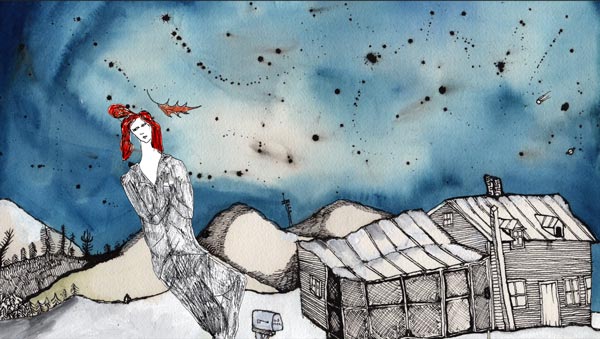
The film contains several illustrations and animated scenes created by Ruth's Granddauther, Bianca. This one is called "Ruth in Land of Goshen"
The Stone family tree is shown with several generations of artists and a sense of "inheriting someone's grief" - do you think the descendents are still grappling with why Walter committed suicide in some way or living with Ruth's grief?
Yes, I do think that. Inherited grief is very interesting to me. The way we carry our parents’ emotional burdens (and joys). All of Ruth’s grandchildren and daughters carry that grief in various ways. I tried to show that in the film. Ruth’s daughter Abigail is perhaps the one who carries it most deeply, even today. After agreeing to let me interview her, she rescinded and did not want me to use any of the interview with her (which was wonderful). I think the experience of his death is still too raw for her. It was deeply upsetting to me that I had to cut her words out of the film (except for a few brief images), but I did because the last thing I would want to do is increase her pain.
The film poses several possible reasons as to why a talented poet like Ruth Stone may not have gotten the recognition she deserved until much later in life. Some possible reasons were: being a woman in a field dominated by men; not understanding or caring much for public relations / marketing; living in Vermont as opposed to say New York City; or simply being unlucky. Why do you think her work went largely unrecognized until much later?
For all the reasons you listed above. Also the fact that she simply did not have time for self-promotion. She was so busy racing around the country trying to make a living and raise three children, that she simply did not have time. And she didn’t seem to care. But I think, I know, she did care.
One of my favorite scenes is when you flip from Ruth in 1972 recalling about when she stopped writing and then immediately jump to her in the 90s basically finishing the thought. Despite not being able to shoot new footage with Ruth, you have so many wonderful scenes with her. Did you wind up using most of the interview footage you had or could find? Was one of the reasons you started the project because you remembered shooting great footage with her?
I’m glad you like that moment! That’s an example of the past colliding with the present. I couldn’t fit everything into the film. There is still some great footage left over. But I tried to include everything that fit thematically. I did have themes that I was following: Creativity, Walter’s death, her career, how she wrote, gender bias, her interest in science, fame, etc.
Yes, there were some moments that I knew were precious: the scene at the beginning with the granddaughters reciting the poem Metamorphosis with her. That moment gave me hope and told me that the film needed to be made.
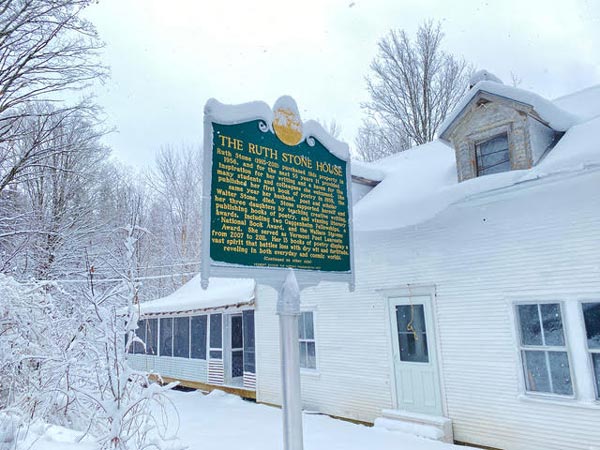
It's nice to have a happy ending for a film about a poet whose life was largely influenced by loss and tragedy. Do you recall how you might have ended the film when you first started working on the project and the Writer's Retreat had not begun? Or did you just start the project without having a definitive ending?
The ending came to me in 2017, when I found out that Bianca Stone and Ben Pease were renovating the house. I had no idea how I was going to end it until then. It came to me quite suddenly and I knew I had to end the film with the house giving birth to new poets and new poetry.
The ending came to me in 2017, when I found out that Bianca Stone and Ben Pease were renovating the house. I had no idea how I was going to end it until then. It came to me quite suddenly and I knew I had to end the film with the house giving birth to new poets and new poetry.
Vermont and New England both seem close to your heart. Do you think you needed to spend some time outside the area before you truly realized it was the place for you?
I am not sure at all that Vermont and New England are “the place” for me. I ended up back here, because my romantic partner had children in the school, and I was kicked out of Hoboken when mercury was discovered in the building I was living in. I loved Hoboken and New York, but I have made Vermont my home once again and have happily made many films here. Vermont has been very good to me and appreciative of me as a filmmaker. My father moved here in 1940 to be a farmer, from New York City. But I am a bit of a gypsy at heart and probably would make films happily wherever I landed. I have dreams of returning to Paris, where I spent my childhood and early adolescence (8 to 15). I have both the city and country in me and love them equally.
You are one of the founders of the Vermont Archive Movie Project - what can you tell me about that?
During the making of the collaborative 6-part film, Freedom & Unity: The Vermont Movie (nicknamed The Vermont Movie), I collected hours and hours of archival footage, old films and photographs of Vermont to incorporate into that series. The director of the Vermont International Film Festival, Orly Yadin, and filmmaker Dorothy Tod (both were part of the Vermont Movie) suggested we create an archive for this material and other Vermont motion pictures. So we set up a database to catalogue hundreds of films made by Vermont filmmakers and/or about Vermont. It’s an invaluable resource. I am still organizing all of my footage!
Finally, how did you feel when the White River Indie Festival set up the 1st Annual Nora Jacobson Award last year? It's a nice recognition.
I was terribly embarrassed. I still am. I hope they change the name. Nevertheless, it is an honor and I am touched that they appreciated my contributions to filmmaking. It is also nice that they created a cash award for a worthy filmmaker.
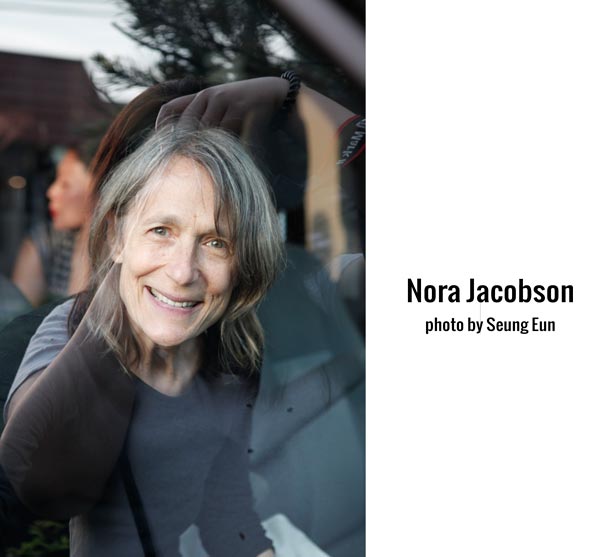
For more on Nora Jacobson visit offthegridproductions.com. For more on the New Jersey Film Festival, which has screenings on select Fridays, Saturdays, and Sundays between January 28 and February 20, 2022, click here.