
"They had it on that farm but I think the owner of the farm upped the rent so they can't do it there anymore but that's another story but yeah they found this place that I don't know if you've been there; the firehouse?"
Australian born and raised Peter Harper is a multi-instrumentalist who's blues-rock and roots music transcends not only cultures but genres as well and he is bringing his band Harper and Midwest Kind to Camp Jam in Mount Holly, NJ this Saturday for a scheduled 8:15 p.m. show at The Union Firehouse.
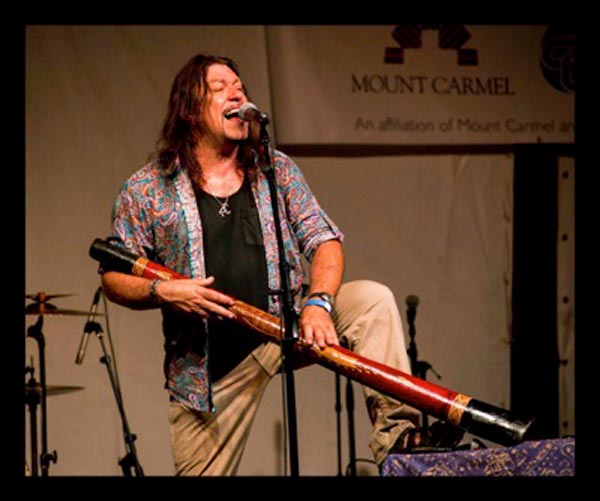
Harper is no stranger to Camp Jam nor the limelight as he has shared stages in venues large and small with the likes of Muddy Waters and Journey but what makes him and his music stand out a bit more than the rest is the use of an instrument which is native to his homeland; the didgeridoo.
“I have a five-piece band," he began. "There is a girl vocalist, my bass player sings, obviously drums and a guitarist and I play the didgeridoo and the harmonica and write all of the songs; I'm a busy boy. I think I'm one of the first; I mean there were bands in Australia that used to use it but they would be mostly indigenous aboriginal bands and they were the ones that taught me how to play it. So, I just got it, fell in love with the sound and then I started using it. I was really worried because Blind Pig Records signed me up and I thought they're not gonna like this didgeridoo thing and they just loved it and they gave me a three CD deal which was excellent. I don't do it on every song so it's not like one of those things where I go, it's that good so I'm gonna do it on every song; I just do it on a few different songs and a lot of them are written about injustices to the Aboriginal people in Australia. So, it'll be a good thing for people to see because it's a real funky sort of band and then with the didgeridoo underneath it gives it a really nice tonality; we just finished a show up in the north of Michigan and they went crazy and that was fantastic; it should be a great night for us there at the firehouse.”
“You know, it is a very difficult instrument to master," he continued, "I mean, there is a lot of circular breathing going on and it's harder when you’ve got a band behind you because they are rocking out and you can't; you have to stay calm otherwise you'll run out of breath. So, I had to get used to that part of me playing it; playing it without anybody behind you is a lot easier. “
As previously stated, Harper has done Camp Jam before but with current events and worldwide shutdowns he wasn't able to showcase some of his newer music or recent releases but this time he says things will be different.
“I did have one album just before the pandemic and it got to number three on Billboard but it wasn't really out there much until recently; that was 2020. I brought out “Rise Up” which is the latest CD and we've been running that probably just for a year because we weren't allowed to go out and play anywhere for a long time; you know?”
“I think right now it's a 90-minute set, it might be an hour and we're on about 8:15 P.M. so everyone will be nice and ready for some loud music. I think my manager is always looking for new stuff so she was looking around for a new thing to do and it seemed like such a cool thing; it's kind of an almost hippie kind of vibe and I kind of like that anyway and I've got the didgeridoo to prove it," he said with a laugh as he explained how he came to find himself playing the event. "We’ve done it about three or four times now and the people running it are just awesome; they're just good people; you know? They really look after you, the crowd is always awesome so it's just great. So, this should be interesting; we’re gonna see what it’s like in this firehouse but I'm sure it’s going to be just as fantastic because they do have a lot of people that always go to Camp Jam and even though now it's gonna be indoors; I'm sure they will still have a nice large crowd to deal with and they do a good lotta publishing and they're always good at that so, we'll just have to see how it goes. I'm sure it'll be fantastic; I know it will be fantastic because they get a lot of different kinds of music; it's not just rockers, not just Blues, it's a bit of everything and I think that's what makes it really interesting because I love blues but if someone does something good; I love that too! I love bluegrass, folk music; I grew up on that in Australia so you know I can understand that kind of thing. I grew up in Perth in Western Australia right over the other side; it’s one of the most isolated places in the world. I used to do summer tours here then go home and then once we got the deal with Blind Pig; they kind of really wanted me to be here. So, I thought well, we wanted to work in America and I think the problem is that Australia is such a small population. The cities are big but there's not much else and it's like Canada; you’ve got Toronto and it's huge and then you’ve got a lot of nothing and then you’ll get another big city and that's pretty much that. That’s pretty much how it worked out because I wanted to come somewhere where I could work constantly without all the breaks and we were traveling so much and it was like, well, we mostly go to the United States and Europe and Europe is a lot closer to the U.S. so it was easier; it was a big decision but we sold our house and came here and it was an interesting transition (laughs). I live in the country now and I didn't understand what a water softener was or any of that stuff. I was a city boy; I didn't I have to learn all of that stuff but it was a lot of fun to do and we’ve got so many good neighbors. I've got 10 acres of land and all of our neighbors are kind of around us; it’s really lovely. There are only about four of them so, it’s a nice spot and it's very quiet.”
Perth's size didn't stop blues legends like Muddy Waters from coming to town and Harper made the most of an opportunity; even if it was by default.
“Muddy came to Perth and I was the only person there that could play harmonica so I got the gig,” he said with that now familiar laugh. “I was pretty young too when John Mayall actually did one of my songs on his album. I jammed with Journey of all things; they came and saw us playing in Iowa and they wanted me to get up on stage with them at their next stadium gig; I did that and it was a lot of fun. I was there when Neil Schon started ripping it up. I've opened for Walter Trout who is a dear friend of mine, I've known him forever and he's a fantastic guitar player and a wonderful person; such a decent man. So, whenever I see him, he always gets me to come up on stage with him and Paul Nelson of course; he used to work for Johnny Winter and he's a good guy. He's very humble about his playing, he doesn't know how good he is which is probably a good thing. In this business some people think they're better than they actually really are and I know because I've employed a few (laughs) but not this band though.This band is a really good and I'm looking forward to shipping us out there and doing the show. I’m sure it'll be fantastic actually and the sound will be awesome of course in that firehouse.”
The band? Do tell us about this band and who writes the material.
“I've been through a few different players because a lot of people think that touring is easy fun and it's actually a lot of hard work. So, you'll get somebody coming in here thinking, this will be awesome and then they go out on a run and they say, it's not for me and yeah, that happens. My bass player was originally with me back in 2000 and he was with me for quite some time; seven years or something like that and then he went off to do something else because I think the difference is that here I’m the songwriter, they don't write with me, I write everything. So, it's a little different than a band where they all sort of write together and do all that sort of stuff. I've never done that; I've always remained independent with my songwriting. Sometimes I’ll go off and work with other people who are doing other projects, different artists will want me to do some work for them and so I’ll do that but as far as my band goes; it's just my songs and they put their little twist to them. It was tougher before but now that I've gotten a name it’s a lot easier to get players to work with me. Some may be with me a year; some may be with me for five years; it just depends on how they feel. We treat them well; we pay them well and I think that's all I can do; I can't do much more than that. We call them contractors because under the tax law that’s what we have to call them; sub-contractors (laughs). These guys that I have now I’ve had for quite some time and they are just awesome to work with. My bass player Lee Lewis used to play with TLC, I think Bobby Rush and he was with Eddie King for a while and he’s such a great bass player. I met my drummer doing session work and so we all have a connection and that's how it usually is when you get a band; there is some connection that gets you the next player when one decides that they wanna go off and get married or whatever happens or when a girlfriend gets sick of him being on the road and then as soon as he quits the band the girl dumps him because they liked them better as a musician (laughs).”
So, armed with a great pedigree, a hard-working band and a didgeridoo; what can we expect at Camp Jam when they take the stage?
“I tend to change it up quite a bit because you don't want anybody coming to see you and say, oh he was doing that song ten years ago; you know? I like to mix it up and I will be putting some of the older songs back in because you know a lot of our fans go; could you do that one again? Well, that was ten years ago and then my band goes yeah, it's a great song and I’ll say, OK and then we'll put it in and it's new to some people. So, I guess because not everyone has seen us from the beginning, I think it's nice to bring back some of those old ones and then swap them out. I try to do a different show every year, different music, different kind of stuff and then there's always someone that says; why don't you do that one anymore? I've only got 90 minutes, I've written more than 300 songs, I can't get them all in, in 90 minutes; right?”
“I also know that you can’t make everybody happy but we kick it in, we're a highly motivated band and everyone moves around and Lee is probably the coolest looking bass player on earth. He plays a right-handed bass left-handed which looks really weird but the strange thing is; I’ve never seen anything like it in my life and it's why I can't watch it because it freaks me out. I asked him why he just doesn’t flip it over and he says, “I'm so used to playing it like this.” That would be like me playing the harmonica upside down or backwards but he sounds good and I guess that's all that matters and he's a great player. I've got a young guitarist out of Columbus, OH and he's a hot guitar player and a really nice kid. He's 23 but he's a mature 23, he's got his act together, he's a good man and I love him dearly. Bobbi my manager sings in the band as well so I’ve got the nice female voice in it which just adds to the three-part harmonies which work really well.”
To discover more about Peter Harper and Midwest Kind, please visit https://harper.biz/ and to find out more about Camp Jam at The Union Firehouse; please go to https://www.facebook.com/TheUnionFirehouse/.
That's it for this week! Please continue to support live and original music and until next week....ROCK ON!