

Caribbean blue: Jadwiga Morelli's Cuban dream.
A photograph of a house tells us something important about the photographer. She’s not inside it. A painter, a sculptor, or a printmaker can work from memory. She can sketch a building from the street, unlock the door, and render a picture of the exterior from a studio on the interior. The photographer doesn’t have that flexibility. For her, creation of a work of art implies separation from her subject. Maybe that’s why photographers always feel like outsiders.
North Jersey street photographers, for instance, must cope with an entire river running between the land they’re standing on and the nation’s most famous skyline. They can head to the waterfront and direct their lenses toward the buildings on the far bank, but every shot testifies to how far away they are from New York City. They may scout it, apprehend it, frame it, and subtly critique it, but they aren’t part of it.
A ghostly sort of alienation hovers over Garden State photography: outsiderdom, estrangement, distance, and remoteness from the empire even as we can see the darn thing from the other side of the Hudson. The “North Jersey Photographers’ Exhibition,” the second group photo show of the year at MoRA (80 Grand St.), is heavy with barriers, closed doors, shuttered windows, and tall walls viewed at a distance. These photographers can bring the camera to the steps of the cathedral, but they can’t come inside and join the congregation.

Chains, posters, and priority mail: Christian Santiago's streetscape.
The show, curated by Ray Schwartz and Joseph Shneberg, is full of excitement, color, spectacle — and of the largest, splashiest, most exuberant prints are images of Manhattan taken from New Jersey. They carry the cinematic quality that we associate with drives on the Turnpike extension and walks along the Hudson: a confrontation with towers of glass and concrete, sleek, imposing, impersonal, and as elemental as a mountain range, far away, but somehow always in our faces. We may not understand the things that happen over there in those mirrored canyons, but we know they're significant; furthermore, given their height advantage, we reckon that they can see us better than we can see them. Are they even looking our way, or are they preoccupied with their own turmoil?
In Ty Chee’s “Gold and Thunder,” lightning lashes down at the skyscrapers from a fierce pancake of grey clouds. The sunlight that coats the stories of windows with candy-yellow afternoon color lets us know that that atmospheric ruckus is regional: on our side of the river, nothing so dramatic is happening. A threat to the Empire next door threatens us, too, but in another way, we can't share in the titanic clash between city and sky. We’re playing for smaller stakes.

A battery, recharging: Ty Chee's "Gold and Thunder."
The contrast between where we are and what we’re looking at is made even plainer in Arnie Goodman's “Freedom Tower,” a stormy skyline shot that must have been taken from somewhere on the Palisade. In the foreground is Bergen-Lafayette, full of squat yellow-brick blocks and humble industrial buildings huddling close to the earth. Behind them, on the other side of the waterway, is Manhattan, all gray steel, plate glass, and skyward aspirations. It feels like a clash of architectural priorities: one place aggressively vertical, the other stubbornly horizontal.
Jayashtri Venuri’s nighttime photograph of Midtown is a rush of upward energy, with an Empire State Building aglow against the night sky, framed by two towers, and spotted by the cylindrical catchment at Hudson Yards. Where is all this ambition heading? We can’t say. "Fog," another large still image by Danielle Haskins, finds the domed Battery Park City buildings asleep under a blanket of mist, top stories a secret, floors ascending somewhere we can’t see in a cloud city beyond the city we know.
Does this population center contain any people? We suspect they're there somewhere — all of those lights can't be on timers. Perhaps they're like rodents who pop back in their holes the moment they know they're being observed. We who share the photographer's perspective, on the other hand, are out in the open; we're unfortified, squishy, onlookers and chroniclers, tilting at the walls of the castle.
Matthew Lubin's “Bike Ride in Hanoi,” a beautiful black and white shot, finds an analogue on the opposite side of the globe. On the far side of the Red River, there’s commerce and construction, trucks and billboards, and multi-story homes with concrete terraces. On the photographer’s side is a single bicyclist with a wicker basket slung over his handlebars and another crate suspended on a rack over a rear wheel that looks like it’s going flat. The buildings in the background are fully illuminated in Southeast Asian sun; the rider in the foreground is almost entirely engulfed in shadow. All that eludes the silhouette is a conical hat and one clutched hand.
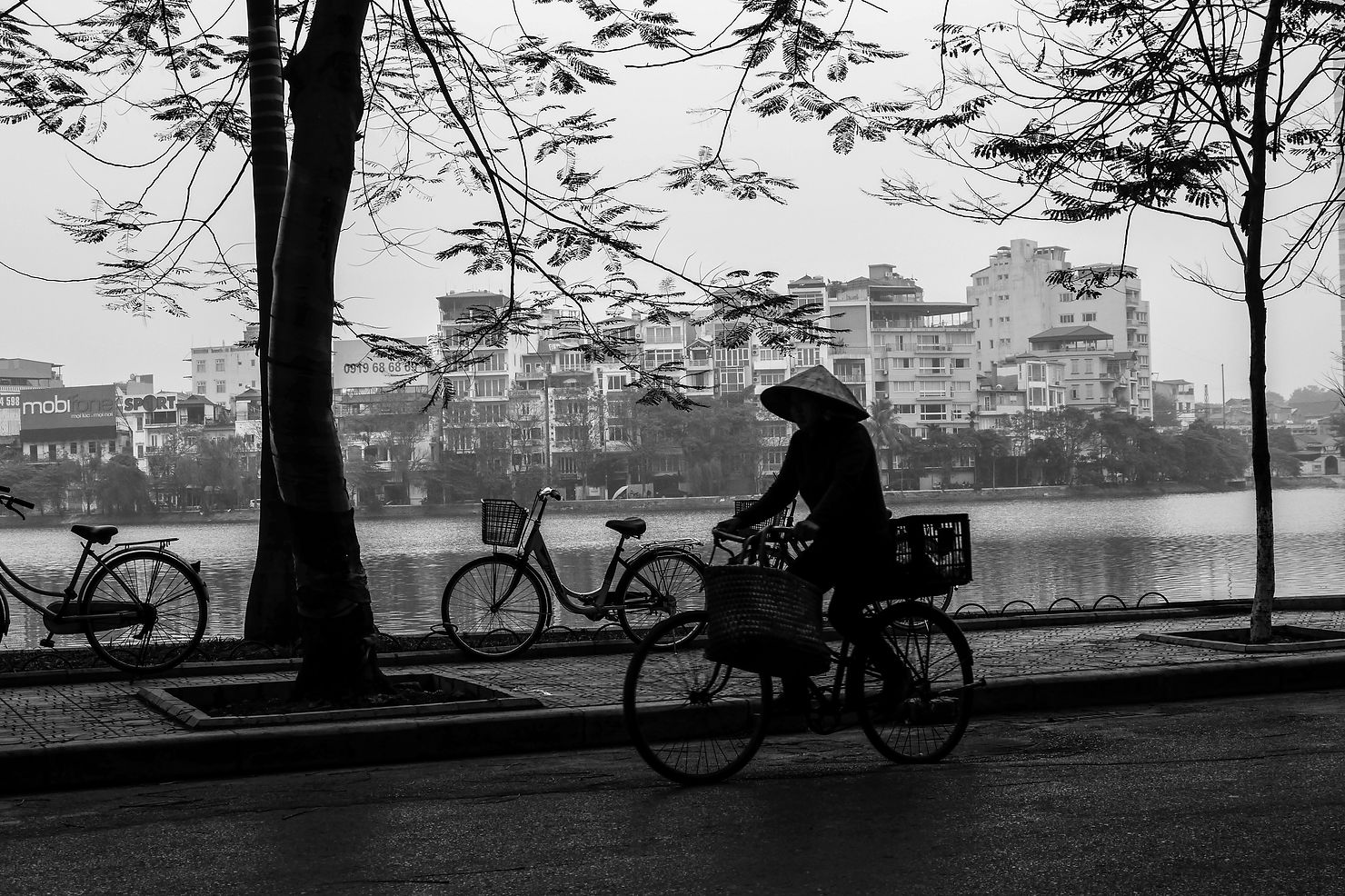
Spirit of the river: Matthew Lubin's "Bike Ride in Hanoi."
As barriers go, rivers are poetic ones. Other separators are less lyrical. In the stark, tough-minded “True Yorkers,” Christian Santiago snaps two pedestrians as they stride alongside a painted brick wall twice their height. Apartment towers peek over the top of a buttress that covers almost two-thirds of the print. Are the True Yorkers the two walkers, or are they those in the houses in the distance? As confident as the human subjects of the photograph look, they’ve got no route to the city behind the black bricks. Reaching the inside is, for outsiders, more than merely knowing where to go. The prize is in sight, but the pathway is nonexistent.
A gentler (and, perhaps, more spiritual) version of the same dynamic is “Cuba in Blue,” a gorgeous, lonesome photograph by Jadwiga Morelli. Once again, we’re shown a couple of walkers — but these are further away than Santiago’s pair, and they’re moving away from us. They’re dwarfed by a long and featureless azure wall that traverses the photo from one side to the other. The squat building is the same color as the deepest part of the firmament. It could be the bulwark that keeps intruders from storming the sky.
Will these two characters find a corner to turn? Does one even exist? The pedestrians in the subtle “Rainy Day,” a wry shot by the photographic storyteller Steven Kushner, appear to be approaching an intersection on a city block, yet the elder of the two is led by her dog, and the junior (a toddler) grips an umbrella with both hands and peeks out from below the rim. A traffic signal halts us in our tracks, but the characters in this vignette don’t seem to acknowledge it.
Even more inward are the six walkers in Kushner’s “A Day at the Beach,” a marvelous and slightly discomfiting shot of girls en route to the ocean, captured in front of the closed double garage of a typically impassive and whitewashed shore house. With towels slung around their necks, they’re looking downward, lost in a private experience, sticking to the sidewalk, oblivious to the huge house behind them. Like the “Rainy Day” mother and child, they’re disconnected from the architecture, treading a path that doesn’t intersect in any way with the town around them.

Sun and implied ennui: "A Day at the Beach," by Steven Kushner.
Part of the reason that Kushner’s photos have the uncanny effect that they do is the artist’s diabolical framing skills. He’s great at slotting human beings into an awkward middle zone in the print, a little elevated, but far enough removed from the top of the shot that the built environment weighs heavily on their backs. Yet in “North Jersey Photographers’ Exhibition,” even when the camera gets close to the human subjects, they still feel alienated, trapped outside of institutional structures, pinned against walls that won’t yield for them.
Barry Richards, for instance, contributes a lockdown-era shot of a distressed woman on the stoop of a dilapidated building. It looks boarded up, the doors won’t open, and the Christmas wreath hung on the knob feels like insult heaped upon injury. The first-rate portraitist Grant Hardeway shows us a man under a Hackensack River crossing, raincoat on, cigarette between his fingers, and staring into the distance as the steel and concrete bridge behind him resolves into mist. Even Justin Gonzalez’s glamour shot of a leggy model in a short red slip feels, in this context, like a commentary on exclusion. She’s on her back on the boarded-up window of a concrete building, she’s jammed her shoes into the masonry, and she’s slipped her bare feet into the grooves between the great stone slabs in the facade. It’s sexy, but it’s also an image of a woman with nowhere to go. Telling it is that the character in “North Jersey Photographers’ Exhibition” that seems to have the most agency is Zach Mayo’s cheerful Navride delivery robot, digital eyes glowing, flag flying, bouncing along the pavement like it owns the place.

Just mad about saffron: "India Square," by Frank Hanavan
At least one human being in the show does manage to merge with his city without losing any of his idiosyncrasies. In my favorite shot of a show containing many brilliant images, Frank Hanavan brings us a middle-aged man in “India Square,” beads around his wrist, cellphone in hand, and a heavy backpack slung so low it bounces against his butt. His saffron robes harmonize with the yellow parking pylons of the garage to his back, the mustard-colored bricks of a run-down hotel, and the Bollywood-inspired street art in the background. He could be coming from a house of worship, pausing by the trashcans to catch his breath as he waits for his car. We don’t see his face, but we don’t need to: Hanavan invites us to inhabit his perspective. Barriers and barricades fall away. And as Juan Giraldo shows us in a hopeful little print, somewhere a door swings open.
(The MoRA show will be on view every weekday between now and Aug. 2 from 11 a.m. until 2 p.m. Should you get to the gallery and find the outside door locked, call 201-422-3593.)

Tris McCall regularly writes about visual art (and other topics) for NJArts.net, Jersey City Times, and other independent publications. He's also written for the Newark Star-Ledger, Jersey Beat, the Jersey City Reporter, the Jersey Journal, the Jersey City Independent, Inside Jersey, and New Jersey dot com. He also writes about things that have no relevance to New Jersey. Not today, though.
Eye Level is an online journal dedicated to visual art in Jersey City, New Jersey. A new review will appear every Tuesday morning at 8 a.m., and there'll be intermittent commentaries posted to the site in between those reviews.
Eye Level is made possible by an Andy Warhol Arts Writers Grant.