


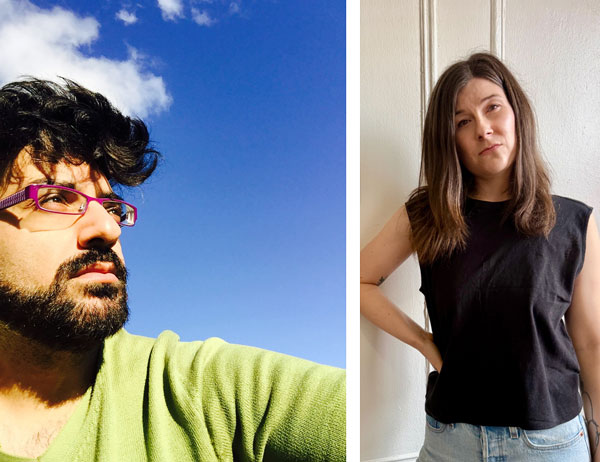
(PRINCETON, NJ) -- Princeton University's High Meadows Environmental Institute and Lewis Center for the Arts and The Civilians, a New York City-based theater company, have announced the 2026-27 artists of their collaborative initiative, The Next Forever: playwright Lyndsey Bourne and actor/writer SEVAN.
The Next Forever is a partnership that seeks to create new stories for a changing planet, exploring how dynamic storytelling can engage vital environmental subjects and provide the vision and inspiration society needs to navigate the challenges of our planet's future — the "next forever." The artists will spend time on the Princeton University campus, engage with faculty and students across disciplines, and participate in an ongoing series of public events and performances over the course of a year-long residency and two-year commissioning agreement. They join artists from the first three years of the program, Kareem Fahmy, AriDy Nox, Kate Douglas, Kate Tarker, Gloria Majule, and the theater collective Lightning Rod Special, who are continuing to develop the works they began during their residencies.
The Next Forever initiative asks: "What stories can we tell to find our way out of the planetary crisis we're in?" relating to climate change, biodiversity loss, ecological collapse, and food insecurity. The initiative provides forward-thinking artists unparalleled access to a cross-disciplinary range of knowledge and ideas—of scientists, conservation psychologists, historians, policy and communications experts, and fellow artists, among others. The program supports artists as they pursue rigorous inquiry into their subject matter alongside some of Princeton's greatest thinkers. The Next Forever also funds a series of commissions of theatrical works that offers new visions for how humanity relates to the world around it.
Lyndsey Bourne is a Canadian writer, teacher, and doula. She teaches writing and devising at Playwrights Horizons Theater School (New York University Tisch School of the Arts) and practices beekeeping at her community garden in Flatbush. Her plays have been developed or presented at La MaMa, Rattlestick, Playwrights Horizons, The Civilians, Page 73, The Ojai Playwrights Conference, MTC, New York Stage and Film, Ars Nova, The Public, and others. She was a member of the 2024–2025 Civilians R&D Group, Page 73's 2025 Writers Group, EST/Youngblood, Ars Nova's Play Group, and the New Georges Jam. Bourne has held residencies at SPACE on Ryder Farm, MacDowell, and New Roots. She holds a B.F.A. from New York University and an M.F.A. from Brooklyn College, where she studied with Mac Wellman and Erin Courtney.
Influenced by her work as a doula, her plays explore the explicit body and the bodily in relation to climate and capital. During her residency, Bourne will develop a new work tentatively titled Hurry Up and Burn. The play follows a crew of wildland firefighters on and off the fire line, living with the physical, psychological, and environmental aftermath of fighting wildfires. The play will track how prolonged exposure to smoke and extreme heat, to mental and physical exhaustion, and to fire itself, quietly reshapes bodies, labor practices, environmental landscapes and daily life, exploring the effects of wildfire not as a series or season of catastrophes but as an intimate, pervasive invasion.
SEVAN, who uses a single name, is an award-winning, immigrant, Middle Eastern, North African, and South Asian (MENASA) actor-writer whose work has been developed and produced in New York and London with the Bush Theatre Emerging Writers Group, the Shubbak Festival, Ensemble Studio Theatre/Sloan, the Old Vic, Playwrights' Center, Theatre Royal Stratford East, National Alliance for Music Theatre, the Orchard Project, PlayPenn, Marin Shakespeare, New Arab American Theater Works, Pipeline Theatre, and The Public Theater Emerging Writers Group. He is the recipient of a Folger Shakespeare Library Artistic Research Fellowship.
SEVAN's project, The Shore is Not Where We Left It, is a tri-narrative, mixed-media stage play set around Chilika Lake in Odisha, India, where saltwater intrusion and shifting monsoon patterns are reshaping land, livelihood, and sacred practice. The play braids three timelines: a present day Mahari temple dancer watching her village and ritual economy sink into brine; a 1930s British clerk assigned to map the lagoon and catalogue local worship, whose notes help turn living knowledge into extractive record; and a future eco-archivist, in 2100, using AI-assisted reconstruction and climate simulation to piece together a vanished cosmology in which gods once lived in water and wind. The Shore is Not Where We Left It stages climate change as both material flood and cultural erasure, asking what can be carried forward, and what must be mourned, when an ecosystem becomes uninhabitable.
"It is a pleasure to welcome Lyndsey Bourne and SEVAN to Princeton, continuing our important partnership with The Civilians and the High Meadows Environmental Institute," said Judith Hamera, chair of the Lewis Center. "Both bring impressive records of theater-making to The Next Forever initiative, and their rich and complex projects investigate two of the most profound challenges of our changing climate: those involving fire and water. We in the LCA believe art comes from questions and materializes in collaboration. I'm confident that the questions Lyndsey and SEVAN explore with us will both create and benefit from generative collaborations on campus."
"We are delighted to welcome this new cohort of artists to Princeton," said Gabriel Vecchi, director of the High Meadows Environmental Institute, who is currently on sabbatical. "At HMEI, we see the humanities as essential to environmental studies. This collaborative, interdisciplinary dialogue yields new ways of understanding the environmental challenges that confront society. The resulting work can help shape how audiences comprehend our future—literally our Next Forever."
Bourne and SEVAN began their residencies in September with visits to the Princeton campus.
The 2023-24 inaugural artists, Kareem Fahmy and AriDy Nox, presented an evening of artist discussions and in-process excerpts of their new work in April 2025. Fahmy's play, Riparian States, tells the story of how a new Nile River dam has brought Egypt and Ethiopia to a geopolitical breaking point. Nox's interactive reverse-ancestral play features young descendants with one burning question for their ancestors, "Why Ya'll Hate Earth So Bad?"
2024-25 artists Kate Douglas and Kate Tarker have continued development of their respective plays begun last year based on their ongoing research. Douglas' new work, If I Forget Thee, O Earth, is a full-length play that puts the cosmic and the terrestrial in the context of mass extinction events (present and past) through the lens of astrobiology. Tarker's play, Topia, is an irreverent, multigenerational play about climate change and authoritarianism in Providence, Rhode Island. They presented a behind-the-scenes look at their projects and process last February.
2025-26 playwright Gloria Majule and theater collective Lightning Rod Special continue to develop their new works. Majule's play, set in a post-apocalyptic world where Africa is the only surviving continent, follows a team of African scientists who develop a time machine to travel back in time and warn humanity of the impending doom that lies ahead. Untitled Climate Change Sex Farce, the play-in-development by Lightning Rod Special, incorporates the group's unique brand of acerbic political satire. Setting their story on the eve of the wedding of two wealthy young Americans, the company notes that their drama unveils the absurdity of humanity's self-obsession and its persistent disregard for mounting environmental catastrophe.
The Next Forever builds on the partnership between The Civilians and Princeton that began in 2009 with the development of the musical, The Great Immensity, one of the first American plays to address climate change.
As part of The Next Forever initiative, The Civilians' Founding Artistic Director Steve Cosson co-teaches an undergraduate course at Princeton each spring. Cross-listed between the Program in Theater and Music Theater and the Program in Environmental Studies, "Investigative Theater for a Changing Climate" is taught by Cosson and theater director and arts-based researcher Khristián Méndez Aguirre. The course, which is open to undergraduates from all disciplines, explores how dramatic storytelling shapes responses to environmental issues, blending documentary-based theater and eco-dramaturgical approaches to create narratives that stage environmental injustice. The Next Forever artists are guest speakers in the course.
High Meadows Environmental Institute—the interdisciplinary center of environmental research, education, and outreach at Princeton University—advances understanding of the Earth as a complex system influenced by human activities and informs solutions to local and global challenges by conducting groundbreaking research across disciplines and preparing future leaders in diverse fields to impact a world increasingly shaped by climate change. More than 160 faculty, representing 30 academic disciplines, are affiliated with HMEI and contribute to the Institute's environmental research and teaching activities.
The Lewis Center for the Arts at Princeton University believes that art arises out of questions. Its classes and minors in creative writing, dance, theater and music theater, and visual arts, and in the interdisciplinary Princeton Atelier, operate on the principle that rigorous artistic practice is a form of research, innovation, discovery, and intervention. Like scholarship of any kind, rigorous artistic practice is a way of interrogating that which is accepted or understood to break into the territory of the unknown or under-explored.
Founded in 2001, The Civilians is a New York City company that creates exuberant "investigative theater" using interviews, research, and up-close collaborations to dive into the lives of others. Through developmental programs such as The R&D Group and the Next Forever, the company nurtures the work of leading, emerging and established playwrights and composers and other theater makers. Celebrated productions include The Great Immensity (a globe-crossing adventure on the climate crisis), In the Footprint (multiple top-10 lists), and Mr. Burns, a Post-Electric Play (fourth-best play of the past 25 years according toThe New York Times).
The company originated Lucas Hnath's Dana H., recently on Broadway and included in Top 10 of 2021 lists by The New York Times and Time magazine. The Civilians was the creative home of composer Michael Friedman from 2001 until his passing in 2017. The company was Artist-in-Residence at WNYC's The Greene Space and previously at The Metropolitan Museum of Art. Most recent productions include a co-production with The Vineyard of the Anne Washburn play The Burning Cauldron of Fiery Fire, the musical Sex Variants of 1941, which had a developmental production at The Skirball Center in fall 2024, and Radio Downtown, an innovative stage work exploring the avant-garde artists of the 1970s, inspired by interviews from the WNYC archives. Top critics have called The Civilians "endlessly inventive," and "groundbreaking." Led by Founding Artistic Director Steve Cosson, The Civilians continues to reinvent theater for a world on the edge.



Wednesday, Nov 04, 2026
@ 7:00pm
McCarter Theatre Center (Matthews Theatre)
Princeton, NJ

Friday, Nov 06, 2026
@ 8:00pm
McCarter Theatre Center (Matthews Theatre)
Princeton, NJ
There are multiple performances including:
Friday, Nov 06, 2026
@ 8:00pm
McCarter Theatre Center (Berlind Theatre)
Princeton, NJ
Thursday, Nov 12, 2026
@ 7:00pm
Princeton Art Museum
Princeton, NJ
There are multiple performances including:
Friday, Nov 13, 2026
@ 8:00pm
McCarter Theatre Center (Matthews Theatre)
Princeton, NJ