

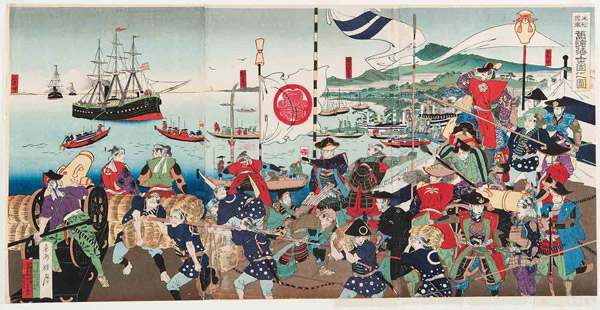
Toshu Shogetsu's “Arrival of American Ships: Picture of a Gathering of Feudal Retainers” is a print dated 1889. Peter Jacobs
(NEW BRUNSWICK, NJ) -- The latest exhibition at the Zimmerli Art Museum at Rutgers University-New Brunswick traces the cultural exchange between Japan and the United States starting from the mid-19th century to the present. The exhibition runs from September 9 through February 14, 2027.
Japan In/Out of View begins in the 1860s, when Rutgers hosted some of the earliest Japanese students visiting the U.S. and became the first university in America to admit students from Japan as early as 1867.
The university also is hosting "Rutgers Meets Japan: A Celebration of Friendship" on September 12 at Kirkpatrick Chapel (81 Somerset Street) in New Brunswick from 3:00pm to 5:00pm. The event - featuring a ceremony with Buddhist and Christian services, a traditional Japanese song performance and presentations by a descendant of Griffis as well as students of Rutgers and the University of Fukui – celebrates the 150th anniversary of the publication of The Mikado's Empire by William Elliot Griffis, an 1869 Rutgers College graduate. For his achievements in bridging Japan and the U.S. through his lectures and publications, the emperor of Japan in 1926 bestowed Griffis with the Order of Rising Sun, Second Class, a Japanese decoration of honor.
Zimmerli Art Museum is located at 71 Hamilton Street in, New Brunswick, New Jersey. Admission is free.
Nicole Simpson, the museum's curator of prints and drawings, organized Japan In/Out of View along with Fernanda Perrone, an archivist who heads the exhibitions program for special collections and university archives at Rutgers University Libraries and the curator of the William E. Griffis Collection, and Haruko Wakabayashi, an associate teaching professor with the Department of Asian Languages and Cultures at the Rutgers School of Arts and Sciences.
Wakabayashi, a cultural historian of premodern Japan, discusses the exhibition, Rutgers' history with Japanese students and artists employing both inside and outside perspectives.
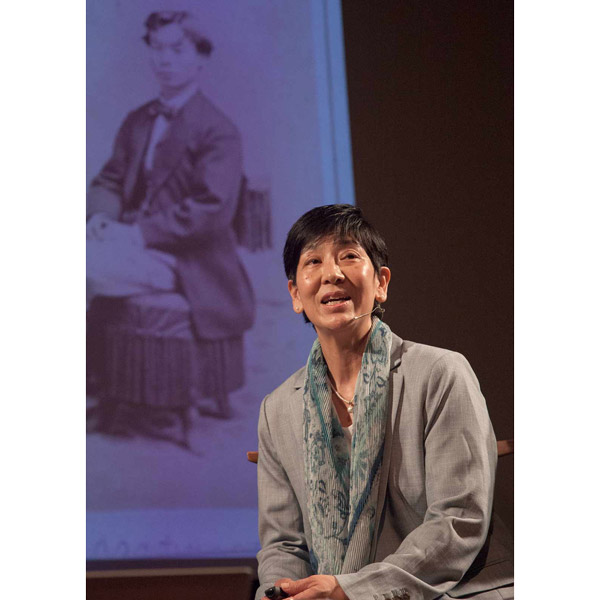
Haruko Wakabayashi, an associate teaching professor at Rutgers, helped curate the exhibition. Photo © George Hirose
What inspired the concept for Japan In/Out of View, and why is this exhibition relevant today?
The exhibition has been organized as part of the celebration of historic friendship between Rutgers and Japan. This year marks two important anniversaries: the 150th anniversary of William Griffis' The Mikado's Empire and the centennial of his final visit to Japan in 1926 to 1927, during which he was awarded the Order of the Rising Sun.
During Griffis' years at Rutgers, dozens of Japanese students came to New Brunswick to pursue their studies in the United States. Griffis became their friend and tutor, and after graduating, he accepted an invitation to teach in Japan, where he lived from 1870 to 1874.
The story of Griffis and these Japanese students represents one of the earliest examples of cultural and intellectual exchange between the United States and Japan. In today's political climate, we believe there is particular value in reflecting on the contributions of Griffis, other Rutgers alumni who became teachers and missionaries in Japan, and the Japanese students who studied at Rutgers.
Together, they played an important role not only in Japan's modernization but fostering enduring friendship between Japan and the United States and in promoting mutual understanding and respect.
The title suggests shifts in perspective. What does Japan In/Out of View mean to you?
Griffis and the Japanese students had the opportunity to see Japan both from the inside and the outside. By teaching in Japan and engaging with his Japanese students for more than three years, Griffis saw Japan from the inside in a way that no foreign visitors could. His view of Japan forever had been changed.
The same was true for the Japanese students who came to Rutgers. They had the opportunity to view Japan from the outside and learn how others viewed Japan. This experience must have had an immense impact on their vision of how Japan should be reshaped as a modern nation as they applied what they learned from the West and at the same time, retained its unique identity and strengths.
The works by Japanese and Japanese American artists in this exhibit demonstrate that such an experience is not unique to historical encounters. They, too, struggled to develop their own styles as they tackled with the "Japan" that was within and without.
As a scholar of Japanese history and culture who studied in the U.S. and now teaches here, I continually question how best to convey my understanding of Japan to my non-Japanese students. There is much to learn from Griffis and the early Japanese students in this respect.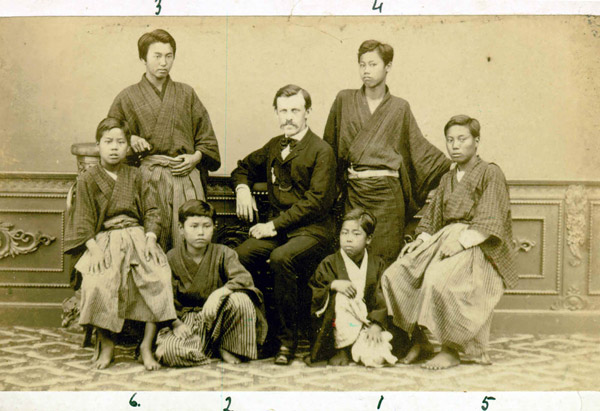
This photograph features American educator William Elliot Griffis (center) with six of his students in Fukui, Japan, circa 1873. William E. Griffis Collection/Rutgers University Libraries
The exhibition spans from the 1860s to the present. What overarching story were you hoping visitors might take away from that historical arc?
The photographs and historical materials from the early period provide "raw" accounts of the challenges and fruits of the initial encounters. While they may have taken different forms, the experiences and knowledge acquired from these encounters – in both directions – have led to views of Japan In/Out of View in the present.
I hope the first part of this exhibition will help the visitors recognize the historical accumulation of these experiences that lie behind the artistic expressions of the works they see in the second half.
What surprised you most during the curatorial process?
I would like to first give credit to the museum curator, Nicole Simpson, who designed and curated most of this exhibition. I was initially surprised that the museum decided to feature the more recent works by Japanese and Japanese American artists together with the story of the early Rutgers-Japan exchange.
Because the materials in the Griffis collection at Rutgers present truly unique and personal accounts of the individuals' early encounters with Japan and the U.S., the two sections actually work very well to bring new light and better understanding of the complexities of cultural exchange that are inherent in works by modern Japanese and Japanese American artists.
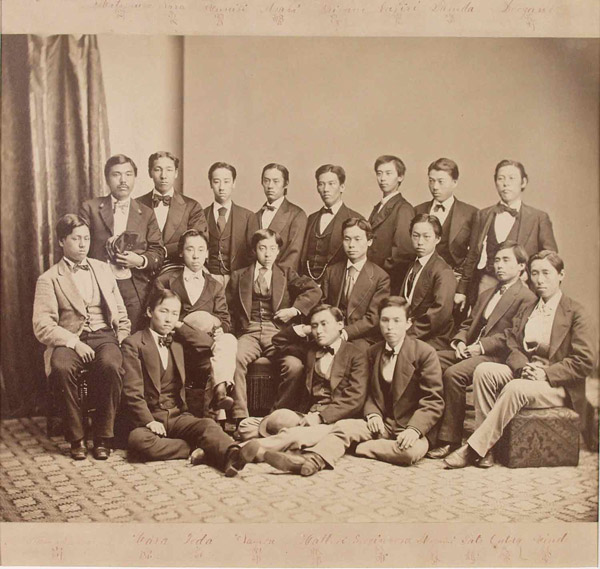
This photo, dated 1871, is a group shot of Japanese students in New Brunswick. William E. Griffis Collection/Rutgers University Libraries
The exhibition begins with some of the earliest Japanese students at Rutgers. Why is that chapter of the university's history significant?
Rutgers was the first university in America that admitted students from Japan as early as 1867. In the 1860s and 1870s, New Brunswick had become a hub of Japanese students who aspired to study in the U.S. The knowledge and experience they acquired at Rutgers had an immense impact on how they envisioned "modern" Japan.
At the same time, their presence changed the lives of their American teachers and classmates, many of whom became teachers and missionaries in Japan, in unimaginable ways. The history of Rutgers-Japan exchange is a testimony to how two very different cultures can meet, engage, and influence each other.
As we celebrate Griffis' achievements in bridging the U.S. and Japan, it is also important to recognize the efforts of those who kept this history alive for the past 150 years and forged new friendships between the two countries.
The fact that this story continues to impact our relationship is truly remarkable.
Rutgers University-New Brunswick is where Rutgers, the State University of New Jersey, began more than 250 years ago. Ranked among the world's top 60 universities, Rutgers's flagship university is a leading public research institution and a member of the prestigious Association of American Universities. It is home to internationally acclaimed faculty and has 12 degree-granting schools and a Division I Athletics program. It is the Big Ten Conference's most diverse university. Through its community of teachers, scholars, artists, scientists, and healers, Rutgers is equipped as never before to transform lives.