
Fuchikami Hakuyō, Hakuyō [White Sun/ Hakuyō(Fuchikami)], 1922-1926. Kōbe: Hakuyō Gashusha, Taishō 11-15.
(PRINCETON, NJ) -- Princeton University Library celebrates the art and evolution of Japanese publishing with a new exhibition "The Art of Japanese Publishing: A Selection of Japanese Illustrated Books from the Marquand Library Collection 1660-1960," curated by Nicole Fabricand-Person, Japanese Art Specialist, Marquand Library of Art & Archaeology and Holly Hatheway, Director, Marquand Library of Art & Archaeology.
Featuring selections from Marquand Library's collection of rare Japanese illustrated books from the 17th century through the 20th century, the exhibition opens Wednesday, September 9 in the Ellen and Leonard Milberg Gallery at Firestone Library, and will be on display through Sunday, December 6, 2026.
The advent of commercial publishing in 17th-century Japan completely revolutionized the Japanese art tradition. For the first time, art was not exclusively created for the upper classes who could afford to commission it for private use. It was designed and produced for a general audience in the form of illustrated woodblock-printed books.
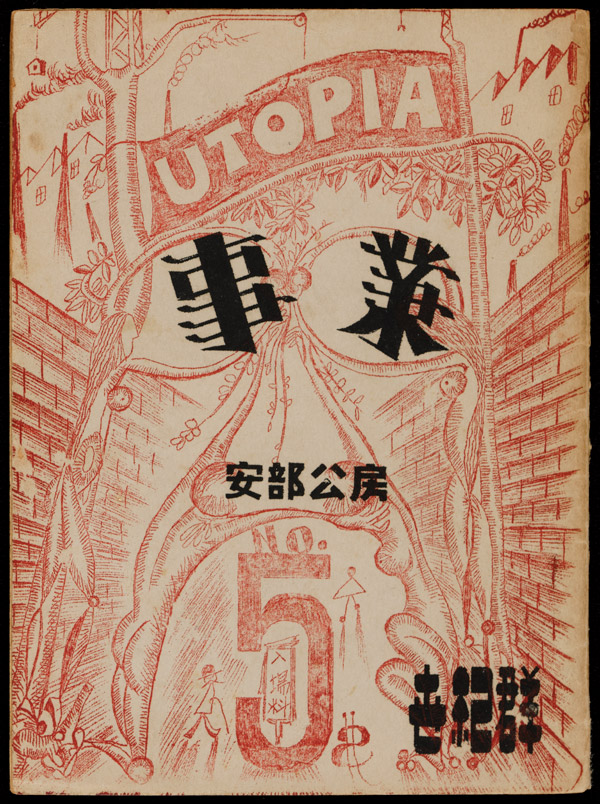
Seikigun,Vol.5, 1949-1950. Tokyo: Publisher not identified, Shōwa 24-25. Image courtesy of Princeton University Library
"Before the commercial printing of illustrated books, art — in the form of paintings and decorative arts — was only affordable to the upper classes through private commission. Illustrated books opened up access to art for the first time to large urban audiences, and much of this was being created by the same artists working for elite sponsors," said Fabricand-Person, who received an undergraduate degree (1976), and an A.M. and Ph.D. (2001) in Japanese Art and Archaeology from Princeton University.
This artistic revolution was the result of newly-minted publishers in Kyoto, Osaka and Edo, who began to experiment with woodblock printing — a process that, for over a thousand years, had been restricted to Japanese temples for the production of Buddhist texts. These beautifully illustrated and commercially published books (and subsequent single-sheet prints) not only impacted the Japanese art tradition but, in the 19th century, inspired the Western art movements of Impressionism, Japonisme and Art Nouveau. The publishing of illustrated books was then revolutionized in the 20th century with the introduction of photography, new printing processes, and artists taking complete control of their work for the first time.
According to Hatheway, "The 'art of Japanese publishing' demonstrates the importance of illustrated books and serials to the Japanese art tradition. Woodblock-printed books, for example, were designed by the same artists and published by the same publishers as the much-lauded Japanese print–and yet are often ignored in art history texts and classes. In the 20th century, serials and self-published books were instrumental in promoting art created 'for art's sake' for the first time in Japan."
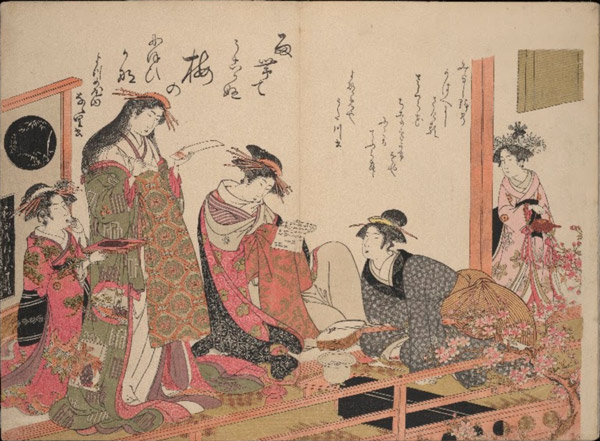
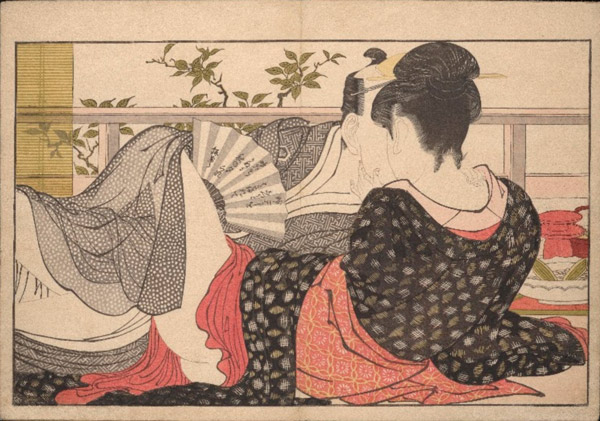
Kitao Masanobu aka Santō Kyōden, Yoshiwara keisei Shin bijin awase jihitsu kagami [Yoshiwara Courtesans A New Mirror Comparing the Calligraphy of Beauties], 1784. Edo: Kōshodō (Tsutaya Jūzaburō), Tenmei 4. Photo courtesy of Princeton University Library
Exhibition highlights: Nine of the items in the exhibition were formerly part of the legendary Shibui Collection. Collected by Japanese art professor and scholar, Kiyoshi Shibui (1899-1992) in the early 20th century, these books are either the only copies still extant or one of very few remaining. All but one later title represents the earliest examples of ukiyo-e (pictures of the floating world) and the beginning of Japanese commercial publishing.
Some of the spectacular objects on display:
[Four Scenes of Lovemaking] (1660)--a handscroll fragment of the earliest known printed work of ukiyo-e.
Kitao Masanobu (1761-1816) Yoshiwara Courtesans: A New Mirror Comparing the Calligraphy of Beauties [Yoshiwara keisei: Shin bijin awase jihitsu kagami](1784)--one of the most important examples of 18th-century publishing (produced with 15 richly saturated colors, sprinkled mica powder, and embossed designs) this book features the culturally refined courtesans of the Yoshiwara pleasure quarters and their elegant calligraphy.
Kitagawa Utamaro (1753-1806) Poem of the Pillow [Utamakura](1788) Believed to be Utamaro's first erotic book–and his most famous–it is particularly noteworthy for both its striking and unusual compositions as well as the block cutter's technical skill.
Fuchikami Hakuyo? (1889-1960) Hakuy? (1922-1926) One of Japan's most historically important photography magazines, it inadvertently documented the early 20th century artistic evolution in Japanese photography from traditional Pictorialism to Modernist Expressionism.
Seiki no Kai (Century Association–various artists/authors) Seikigun (1949-1950) Self-published (mimeographed) and hand-distributed by the artist-writer organization Seiki no Kai these eclectically produced pamphlets were created as experiments in 'synthetic art' and captured the artistic mood of the post-war period.
Hatheway concluded, "The accompanying online catalog includes all the books fully digitized with more detailed descriptions of each, offering the resources of the Marquand Library of Art and Archaeology to students and scholars at Princeton and around the world. It also includes related books and materials from Princeton University Library's East Asian Library and Special Collections, as well as from the Princeton University Art Museum."
The exhibition is free and open to the public Tuesday, Wednesday, Saturday and Sunday from 10:00am to 6:00pm and Thursday and Friday from 10:00am to 8:00pm. The gallery is closed on Mondays. The library is located at One Washington Road in Princeton, New Jersey. For additional information about the exhibition, please click here.
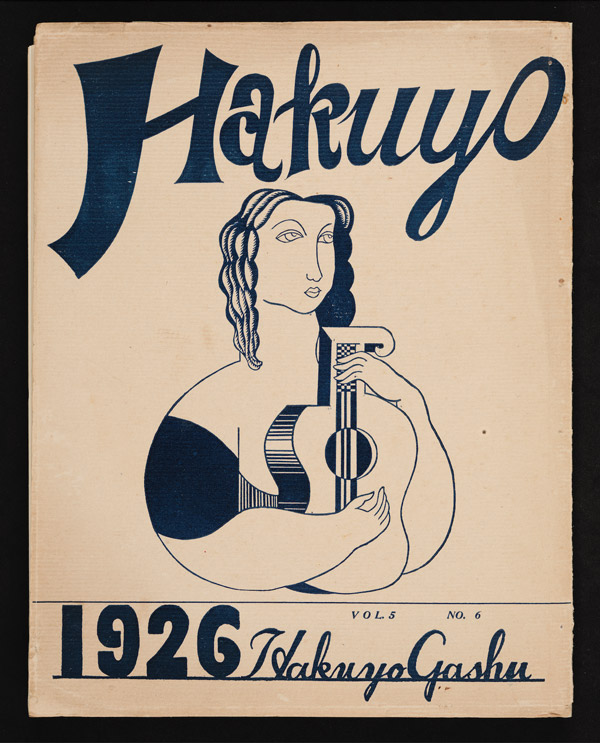
Fuchikami Hakuyō, Hakuyō [White Sun/ Hakuyō (Fuchikami)], 1922-1926. Kōbe: Hakuyō Gashusha, Taishō 11-15. Photo courtesy of Princeton University Library