
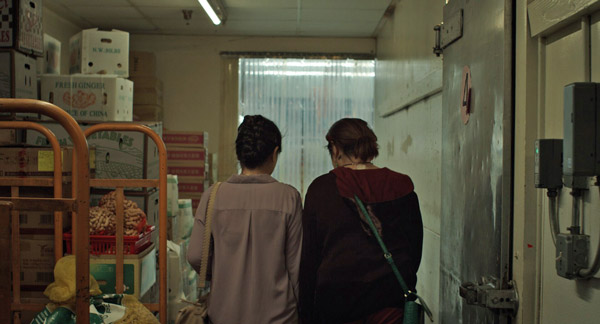
Kim Caicedo’s Finding YiYi is a compelling interpretation of sexuality, acceptance, and identity in its many forms. The film revolves around YiYi, a straight-laced, lonely, Asian woman in her fifties on a journey to find her late grandmother’s lost dumpling recipe.
The film stars Lee Chen as YiYi and Yan Cui as Lucy. There is such authenticity from the pair, which gives their characters depth and dimension. The two have wonderful chemistry and their performances are beyond convincing, adding a raw touch to the film’s already vulnerable thematic elements.
The film opens with a collection of distant memories from YiYi’s childhood; YiYi and a friend make homemade dumplings with a mother figure. The warm kitchen radiates a sense of calm and comfort. The girls go outside and make butterfly hand shadows in the sun. This opening sequence powerfully captures a comforting, golden memory of YiYi connecting with her culture, and bonding with her childhood friend. This warmth is sharply halted by an abrupt cut to a grown up YiYi, awake at night, reflecting on much simpler and happier times. By juxtaposing the color palette, within the first two scenes, the tone of the film is immediately set; we as viewers, get a clue into what we should expect from the film: light and dark, the good and the bad.
In the following scene, YiYi starts her day, attempting to recreate her grandmother’s dumpling recipe. Amidst her pulling out ingredients and placing them on the counter, she accidentally knocks over a bottle of soy sauce onto the recipe card. YiYi can only watch in deep despondency as the card absorbs the dark liquid, entirely consuming her last tether to her childhood. This scene powerfully portrays a tangible loss of self. The erasure of the recipe sparks the beginning of YiYi’s rediscovery of herself.
The film continues, displaying YiYi’s monotonous routine, her daily tasks and errands, and her never-ending search for the right ingredient combinations to recreate the dumpling recipe. She ends up at her local grocery store, where she picks up some more dumpling ingredients. The grocery store is lit with bright overhead fluorescents, bathing the store in a flat, dull light. Regular customers pay for their items, and a soy sauce vendor offers samples. Clearly, nothing here ever changes.
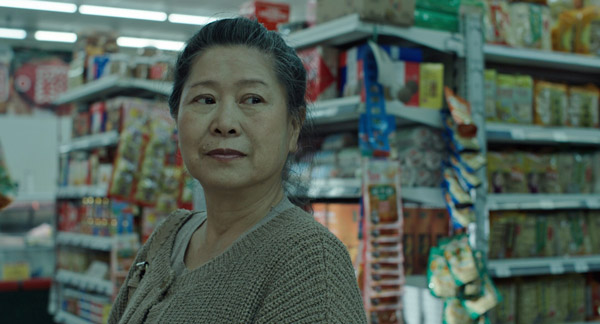
A noteworthy component of this film is its cinematography. Bao Le Cheok shot the film simplistically, allowing the acting and primary themes to be prominent. With its minimal camera movement, the film feels stuck in time, mirroring YiYi’s day to day routine. This especially stands out in the grocery store scene; it is clear that YiYi has been here before many times, and that this particular shopping trip isn't special. That is until she continues wheeling her cart from aisle to aisle… then stops dead in her tracks.
The editing of this film, done by Attila Tayefeh Ghalehbegi, really shines here; a cozy childhood memory interrupts the sterile grocery store, bridging together the identity of YiYi’s childhood friend, Lucy, as well as connecting the central motif of butterflies and the significance of them to the story. The character reveal is beautiful and simple, which highlights the genuine nature that the film possesses. This paired with a previous shot of YiYi glancing longingly at a lesbian couple who passes her, emphasizes the importance of intention within editing and how it can ultimately enhance an already incredible film.
The characterization of Lucy is masterful as it shines light on the stark differences between her and YiYi, but not in an egregious or expository fashion. It stresses the juxtaposing stages in which the two are in; Lucy is out of her chrysalis, while YiYi stays coddled comfortably inside. This also clues us in as to why YiYi is more apprehensive of receiving the olive branch that Lucy extends.
Everything about this film is intentional, including the title itself. It has the connotation of the two girls bridging their emotional and physical gap and reconnecting with each other in adulthood, but it takes on a new connotation of YiYi finding herself as an adult. The title also functions as a reference to the lost dumpling recipe that YiYi spends the majority of the film trying to find.
Overall, Finding YiYi is a beautiful, touching story on rediscovering oneself in a multitude of contexts. It is a deeply stunning story that penetrates the soul and explores how identity truly is a metamorphosis.
Finding YiYi will screen at the 2026 New Jersey International Film Festival as part of Shorts Program #2 on Saturday, June 6, 2026 – Online for 24 Hours and In-Person at 7PM! Get tickets and more info here.
The 31st Annual New Jersey International Film Festival will be taking place on select Fridays, Saturdays, and Sundays between May 29-June 7, 2026. The Festival will be a hybrid one as we will be presenting it online as well as doing in-person screenings at Rutgers University. Most of the films will be available virtually via Video on Demand for 24 hours on their show date. VOD start times are at 12 Midnight Eastern USA. Each General Admission Ticket or Festival Pass purchased is good for both the virtual and the in-person when both are offered. The in-person screenings will be held in Voorhees Hall #105/Rutgers University, 71 Hamilton Street, New Brunswick, NJ beginning at 5PM or 7PM on their show date. General Admission Ticket=$15 Per Program; Festival All Access Pass=$120; In-Person Only Student Ticket=$10 Per Program. For more info on the Film festival go here: https://2026newjerseyinternationalfilmfestival.eventive.org/welcome