
Originally published in Jersey Jazz Magazine. Reprinted by permission of the New Jersey Jazz Society
The big band format is, of course, one that is jazz’s most timeless, enduring, and malleable. A big band could take a classic standard and update it for a modern audience, or transport that audience back to a Jazz Age ballroom. It’s no wonder, then, that so many modern jazz practitioners view the big band format not as an anachronism to be scoffed at, but rather a sanctuary to be revered.
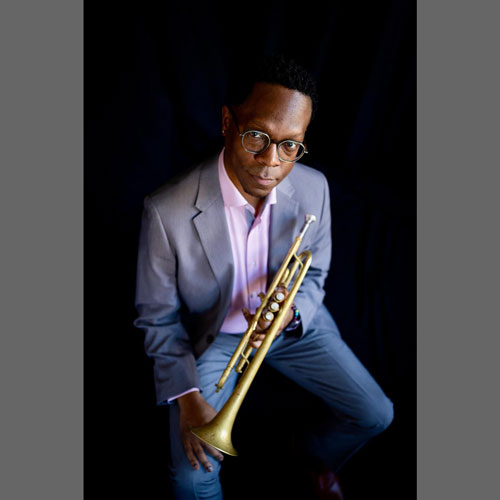
Trumpeter Brandon Lee is one of those musicians. Lee has embraced the big band format and counts himself as a current or past member of many of the finest new and legacy big bands working today -- the Count Basie Orchestra, the Jazz at Lincoln Center Orchestra, the Vanguard Jazz Orchestra, and the Maria Schneider Orchestra, to name a few. Lee is also a Co-Founder and Co-Leader of the Uptown Jazz Tentet, a 10-piece ensemble paying homage to the big band tradition while repurposing it for a modern audience.
Not one to be limited artistically, Lee is also a student of the small-combo idiom. He has released three leader albums that faithfully update the straight-ahead, post-bop heritage for modern listeners. On these albums, Lee skillfully offers his take on beloved standards that, despite their age, really never seem to grow old.
Furthermore, as if the above endeavors weren’t keeping Lee busy enough, he also serves in the orchestra of the Broadway musical Death Becomes Her, which marks his third show, following stints in Some Like it Hot and Water for Elephants.
Finally, continuing the tradition established by his parents, Lee is a dedicated educator. He is currently Adjunct Professor at New York University’s Department of Music and Performing Arts Professions. He also works with younger aspiring musicians, and this month Lee will join the One More Once Jazz Ensemble to serve as a guest artist in a concert program with the Piscataway High School and Passaic County Vocational and Technical High School jazz bands. The events will take place on May 17 and 31 at Crossroads in Garwood, NJ.
As one might imagine, balancing educational, orchestral, and jazz performance endeavors with the ambition and drive to create and push himself as an artist is challenging. The obvious economic benefits of serving in a Broadway orchestra, Lee’s passion for education, and his innate artistic desires, often conflict. Nevertheless, he's up for it.
“The thing that I’ve been following, which is I guess my North Star," Lee said, "has been trying to keep the balance between the things I know I need to do to have a good quality of life, the things I feel I need to do as a musician; and to contribute to this music. That’s been the thing for me. Am I balancing out everything that I want to do in this music? And right now, I feel like I’ve been kind of putting my own stuff on the back burner a bit. I’m trying to get that rolling again.”
Lee was born and raised in Houston, and his parents were both educators. His family members immersed themselves in music, and were active with their Christian faith. These twin passions had natural synergies. All of the Lees were musicians, and they spread the gospel through their music in churches all across Texas.
“My parents made it their spiritual life's journey to go and start different praise and worship ministries at different churches as we were growing up,” Lee explained. “So, we would go to a lot of different types of churches. Sometimes it would be an all-Black church. Sometimes it would be an all-white church in the outskirts of Houston, places that most Black people weren't going to back in that day. But we were right in the middle of the churches, helping them get their praise and worship ministries together.”
Starting out on piano at an early age, he quickly switched to the trumpet. The impetus was Lee’s brother’s drumming prowess. Lee excelled at the trumpet and played in many Houston-area jazz workshops, including some with area peers who also grew up to be major jazz players, such as pianist Robert Glasper and saxophonist Walter Smith III. In high school, Lee competed in Lincoln Center’s Essentially Ellington student jazz festival, winning the Best Soloist award. There, he met an ideal mentor for a young trumpeter, Wynton Marsalis, who helped him get into The Julliard School, which – shockingly in the year 2000 – was about to commence its inaugural Jazz Studies program.
In the 1980s, Marsalis facilitated a movement -- dubbed by many as the “Young Lions” --that saw a return to a traditional swing, bop-inspired jazz sound after a decade that was dominated by rock-oriented jazz fusion. Lee’s sound is generally a natural extension of that movement with his compositions and recordings all being excellent additions to the bop idiom. And, of course, no format is more traditional than the big band.
“When I'm writing music, it usually doesn't come with any kind of preset sort of agenda,” Lee explained. “I would say that the way I write my music is probably because of the musicians that I've been listening to throughout my career. Wynton is, of course, the early influence, but basically all of the Young Lions. That kind of resurgence of swing and jazz was my childhood. I grew up listening to all of them. Whether it was Wynton or Nicholas Payton, Roy Hargrove, all the other guys that were on Criss Cross Records. The musicians who were playing at that time were playing things that were pushing the music a little forward, but at the same time they were tipping their hat to the tradition.
“So, the hours and hours of music that I listened to growing up are swirling in my head when I go to write music. When I go and play, I'm usually trying to keep the musicians that are playing with me engaged by challenging them with music that is complicated, but does not necessarily sound complicated. So, it's the musicians who are being challenged, but the audience is still enjoying what they are hearing.”
Lee' three leader albums -- all worth seeking out on Bandcamp or streaming services -- are 2007’s From Within, 2010’s Absolute-Lee, and 2017’s Common Thread, as well as two albums with the Uptown Jazz Tentet large ensemble. Lee has appeared on dozens of albums a sideman with various big bands, winning four Grammy Awards along the way.
Reviewing the Uptown Jazz Tentet's album, What's Next (Irabbagast Records: 1990), for AllAboutJazz, Edward Bianco wrote that the music was "grounded in the traditions of the Billy Strayhorn, Gil Evans, Duke Ellington big bands . . . these 10 players reveal a swing and swagger similar to today's typical 17-piece modern big band, producing a muscular sound at every turn."
Lee gravitates toward big bands because, "I think that the big band is one of the last things that's around that sort of has this lasting community feel to it. I think it's because of the sheer number of people who are on stage at the same time. You get locked in immediately with three or four different trumpet players. You are therefore immediately within that family, keeping that sort of jazz tradition, community, family, feeling alive, and not feeling so individualistic all the time. It’s about me, as an individual, coming in and helping and contributing to a larger whole, as opposed to everything just being about me.
“Ever since I was a student at Juilliard," he continued, " I’ve always found big bands challenging in a good way, to figure out how to play, how I play, the way I wanted to play, over the big band, but also make it to where I'm still making a statement. How do I play with the Count Basie Orchestra and play within the confines of that band, but also still sound like me, right? That’s a very special, specific skill.”
Lee has also spent much of his career in the classroom. He taught at Juilliard for several years following graduation, and soon after spent an extended period of time as a professor at the University of North Carolina at Greensboro. While Greensboro was certainly comfortable and lucrative, after several years Lee began to miss the New York scene. He landed the professorship at NYU in 2023. In addition to his scheduled clinic with the two high school bands and the Once More Once Big Band, Lee regularly participates in jazz camps with younger musicians. This allows him to perform in New York while continuing his parents’ work as educators.
“I'm very excited to do [the Garwood concerts],” Lee said. "I like to tell students that they need to play Count Basie, Pat Jones, Duke Ellington. If you're in a big band, to never play that music just doesn’t make sense. Look, it's fun to play all these other charts, these funk charts, there's a lot of great music out there. I have a lot of fun playing a lot of those charts that aren't Basie and stuff like that. But for students, I 'm always trying to make sure that they at least have a chance to play through this music, to learn something from it. So, yeah, it'll be a nice mix of things."
Despite a full schedule of big band gigs, teaching engagements, and his Broadway engagements, Lee remains highly ambitious. He wants to spend more time on smaller combos, for example. “With smaller bands, it just feels there's just so much freedom,” he said. “You can get to a level that is pure improvisation. Nobody is coming in with anything preconceived or anything like that. The small group offers more when it comes to creativity, and you have more than one chance to do it, like if you play a week at a club or a month on the road or something like that.
“I'm trying to allow myself to start thinking about projects that I want to start and think of more people who I want to play with. I see myself doing more or less of a lot of the similar things that I'm doing now, but there are other things that I have in mind that I just haven't been able to, like bigger picture things. They're not all clearly formed yet. But as far as my musical career, I just want to do more of my own thing, and see where that takes me.”
No matter where that may be, there can be no doubt that it will be respectful of jazz’s past, while keeping a keen eye on the future.
The New Jersey Jazz Society is a non-profit organization of business and professional people, musicians, teachers, students and listeners working together for the purpose of advancing jazz music. Their mission is to promote and preserve America’s original art form – jazz. The Society seeks to ensure continuity of the jazz art form through its commitment to nurture and champion local talent, along with showcasing outstanding national and international artists providing for the younger generation via arts education programs.