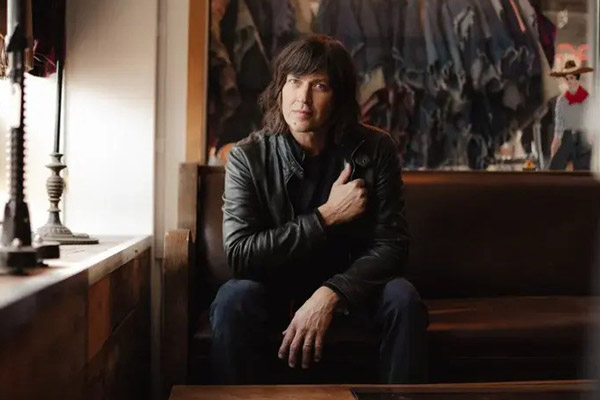

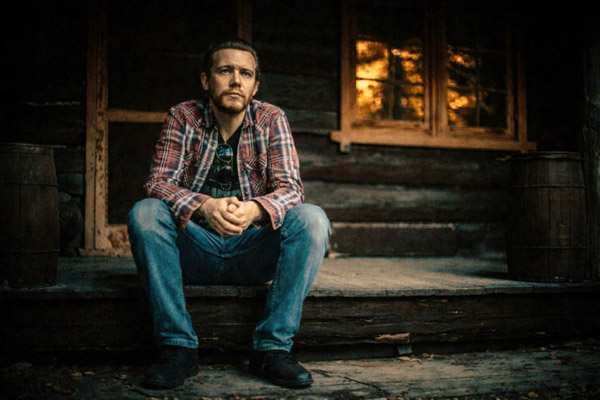
Don Ryan writes songs that feel like they've been left out in the rain—warped, weathered, and quietly glowing. Operating out of the NJ/NYC orbit, his latest album pushes further into that uneasy space between Americana, gypsy jazz, and a fractured strain of psychedelic folk, where jagged arrangements and ghost-haunted lyrics replace anything resembling polish.
Critics have tried to map him—invoking everything from Tom Waits to Elliott Smith—but Ryan resists easy lineage, his work landing somewhere stranger and more singular. His guitar playing, often praised for its deceptive complexity, underpins songs that feel both meticulously constructed and slightly unhinged, a balance that traces back to an origin story as unusual as the music itself. On stage, that tension blooms into something even more immersive, as Ryan blurs the line between performance and spectacle, shifting from wry self-awareness to raw confession without warning. With this new record, he leans fully into that controlled chaos, delivering a body of work that feels less like a collection of songs and more like a mood you can’t quite shake.
Your music feels less like a revival and more like a reworking of familiar forms—what draws you to reshaping Americana and folk into something darker and more unstable?
I think what it is for me is that I'm approaching all of this music from a perspective that's very far outside of it. I spent my teens and most of my twenties listening to extreme metal music like Pantera and heavy stoner stuff like Alice In Chains, so by the time I got really into artists like Wilco and Townes Van Zandt and The Velvet Underground, and all these beautiful bands that might fall loosely under the rubric of Indie or Folk or Psychedelic Rock, I was incorporating them into a writing style that was already very naturally aggressive and explosive and dark.
And honestly, they're not all that different from one another. I was just pointing out to a friend of mine the other day that if you listen to a lot of Fiona Apple's lyrics, aside from the fact that they come from a distinctly feminine place, they could damn near be Pantera lyrics. There's such a similar edge and angst to them.
There’s a tension in your work between beauty and decay. Do you start writing from a lyrical idea, a mood, or something more abstract?
I pretty much always start writing on an acoustic guitar, no matter what I'm writing. I often do this little thing - you can call it a kind of meditation if you want. I tend to call it "guitar yoga" - where I'll literally just cleanse my sonic palate by playing absolute disonant nonsense on the guitar, and then I begin humming along to it. And if you're just letting everything flow and you have zero expectations about what might arise, a lot of the time, something will jump out at you. And then from there, I start to build my chords and melodies.
I almost never begin writing a song with lyrics, but once I have my chords or riffs and my melodies, I almost always work on the lyrics for the chorus next. And then I just let that chorus be my guide as to what I'd like the picture I'm painting to look like.
You’ve been compared to artists like Tom Waits and Elliott Smith—do those references resonate with you, or do they feel limiting?
I love the comparisons to a certain extent, because those are some of my favorites, and of course I hear the influence there. But I do see the Tom Waits one, especially, as way overstated. One reviewer some years back wrote something along the lines of "Don Ryan is the next Tom Waits," and on the one hand, of course I'm stoked if someone wants to compare me to one of the greatest songwriters to ever live. But on the other hand, there's no possible way to live up to that, and I feel like a lot of people took those comparisons a little too seriously.
The way I tend to see it is that if you listen to my music and only hear "Tom Waits-influenced," then you're probably not listening past one or two songs, because there are a ton of other things going on in my music. Besides, there's only ever going to be one Tom Waits. There just isn't going to be a Tom Waits for the next generation. He's that one of a kind.
Your "origin story"—learning guitar in a funeral home—is almost surreal. How much do you think that environment shaped your sense of atmosphere and tone?
This anecdote is kind of funny to me, because it really wasn't all that big of a deal, but it got made into a bigger deal than it actually was. And I know that for a fact, because I was the one who made it into a bigger deal than it was. [Laughs]
It's all totally true that I was taught to play in a funeral home by an amazing teacher out of Carlstadt, New Jersey named Dennis Kimak, and I was learning the dark arts of metal guitar at the time. Now, I've spoken to Dennis about this, and he has no recollection of it, but there was a time for a few weeks there when I was a kid when one of the floors in the funeral home was having some work done on it, so we had to do the lessons in the basement for a while. I distinctly remember being freaked out because there was a door right near us in that basement that was slightly ajar, and in it you could see that pale fluorescent light that you see in every horror movie with a funeral home in it emanating from somewhere back behind that door.
I had asked Dennis at the time if that's where the bodies were kept and worked on, and he smiled and nodded awkwardly and got up to close the door, seeing how freaked out I was.
But at the end of the day, I could've been taking guitar lessons in the middle of an active battlefield and I would've been too hyperfocused on the guitar to realize where I was, so it ultimately wasn't a huge deal. But it really does set a very cool backdrop to where I came from as a musician. And if I'm being totally honest, it's so perfectly "me". Of course the guy with the really weird, dark songs learned to play in a funeral home! [Laughs]
There’s a “dark circus” quality critics have pointed out—do you see your music as theatrical, or does that element only emerge in a live setting?
Honestly, I don't see much of anything that I do as particularly theatrical. I think the "dark circus" thing that critics have pointed out is actually more to do with the fact that I use a lot of circus imagery and musical themes in my songs, just because I love that imagery and that sound. And I think that's also where the Tom Waits misapprehension comes on board for a lot of people. With songs like "The Carnival", "King of the Clowns", and "Ticker-Tape Parade", that's a whole lot of circus right on the surface there!
Your live performances seem to balance humor and something more unhinged or confessional. How intentional is that contrast in the overall project?
I think that contrast just comes from the fact that I am a really goddamn weird dude when it comes right down to it. [Laughs] Contrary to popular belief, most people are usually not 100% introverted or extroverted. It's usually a combination of the two. But for me, I find that I am not only both, but I am extremely both. I would be more than happy to just sit home by myself for weeks on end and just record music. But then when I do go out to have a good time, I'm honestly a bit too much sometimes. That transition from working completely alone to suddenly being around people just flips my personality around 180.
When I used to play with a full band backing me, it was always such a raucous and reckless thing. And as much of a giant pain in the ass it is to be a bandleader, whenever I'm playing out with a tight group that's firing on all cylinders, it just brings out this fucking animal in me. I think it's back to that whole metal thing again.
But these days, I do all the instruments myself in the studio, so on the extremely rare occasion that I do play out, it's just me with an acoustic guitar. And in that situation, I just find myself with not a whole lot to say. [Laughs] Like, I don't want to be that "acoustic guy" who gives a big speech about saving the whales or something before each song, so I tend to invert inward. Strangely enough, whenever I'm like that onstage, that's probably more representative of who I really am and what I'm really like - just shy and kind of in my own shell. But it's the side of me that almost no one ever gets to see.
Your guitar work has been described as intricate but deceptively effortless. Do you think of the guitar more as a compositional tool or a vehicle for expression?
When I was learning how to play, I was totally obsessed with technique. I worshipped at the altar of guys like Dimebag Darrell and Steve Vai and a ton of other shredding maniacs.
But when I was 17 years old, I hit a crossroads in my musical life. I knew I had to choose - either I was going to keep going down that road, and push that technical stuff way further; or I was going to give my all to songwriting.
And I chose songwriting in an instant.
So pretty much every bit of technique that I have was developed in those first few years as a teenager. But it afforded me such an amazing freedom when it came to songwriting, because I found it so much more natural to think outside the box. I didn't feel terribly constrained by an inability to play what I was hearing in my head.
A lot of your lyrics tend toward ghosts, melancholy, and disillusionment—are those themes coming from personal experience, or are they more character-driven?
I think it's a bit of both. The consistent struggle in my life has been with depression, and so I not only naturally write from that perspective all the time, but because I've lived it and it's taken me down so many sad and dangerous roads, I'm also singing about real experiences.
Depression has led me down the road toward addiction many times. It's only natural to want to feel better, and to grab onto anything that can make you feel even somewhat ok. But of course we've all heard the slogans: "that's a road to nowhere," blah blah blah. And of course, that's all true. But when I write songs referencing addiction, which is quite a hobbyhorse of mine, it is 100% from firsthand experience.
Your songs seem to reveal more with each listen—when you’re writing, are you consciously layering meaning, or does that complexity happen naturally over time?
For the most part, I abandoned linear meaning in my songwriting decades ago. It's kind of funny how it happened for me, because there was literally a specific day where my artistic world was blown apart and pieced back together in an instant.
In 2007, I had been going through a terrible time. I was coming off of the breakup of a very promising metal band. We were staring success right in the eye, had a three-time Grammy Award-winning producer who was interested in working with us, and had all these industry people checking us out, but no matter how hard I tried, I just couldn't get everyone on the same page at the same time.
After that band broke up, I started my own band, which was the first time I had ever been an actual frontman before. And it just went nowhere. It had a few fans, but overall, it was met with a really icy reception. And then that band broke up in '07, and I was just devastated beyond belief.
But it just so happened that one day that winter, my then-girlfriend and I were visiting my parents down in Florida, and we took a trip to the Salvador Dali Museum, which is in St. Petersburg, FL, of all places! We did the whole tourist thing and got in a group and had a tour guide and all that.
But I was intentionally lagging behind the group, experiencing these larger-than-life pieces of art on my own terms. And I was also laughing to myself, sometimes out loud, as the tour guide would "explain" each piece, when it was just screamingly obvious that there's absolutely nothing to explain here.
Dali's paintings weren't about one particular meaning. In fact, as far as I saw it, he intentionally stripped his paintings of any obvious meaning whatsoever.
I know it sounds corny, like a BS origin story, but as I left that museum, I knew that was what I wanted to do with my songs. I didn't want to make sense anymore. I wanted to paint pictures with words, nothing more.
And so for the most part, that's what I tend to do.
Of course, some of my songs occasionally do have concrete meanings, but they're pretty rare. It's mostly up to the listener to figure out what my songs mean to them.