
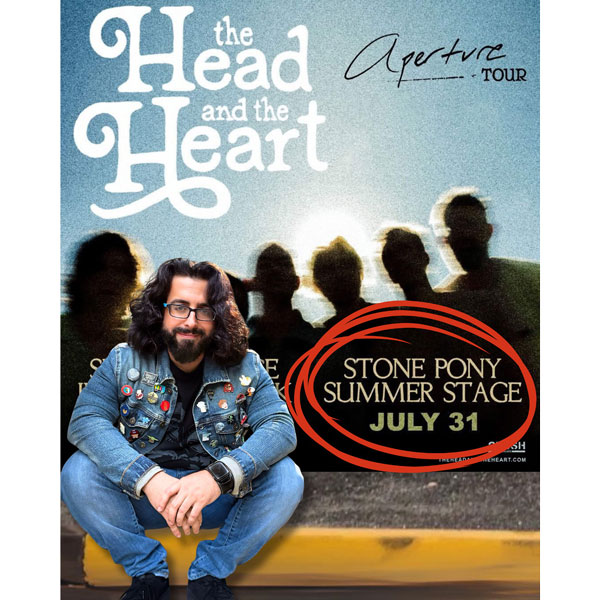
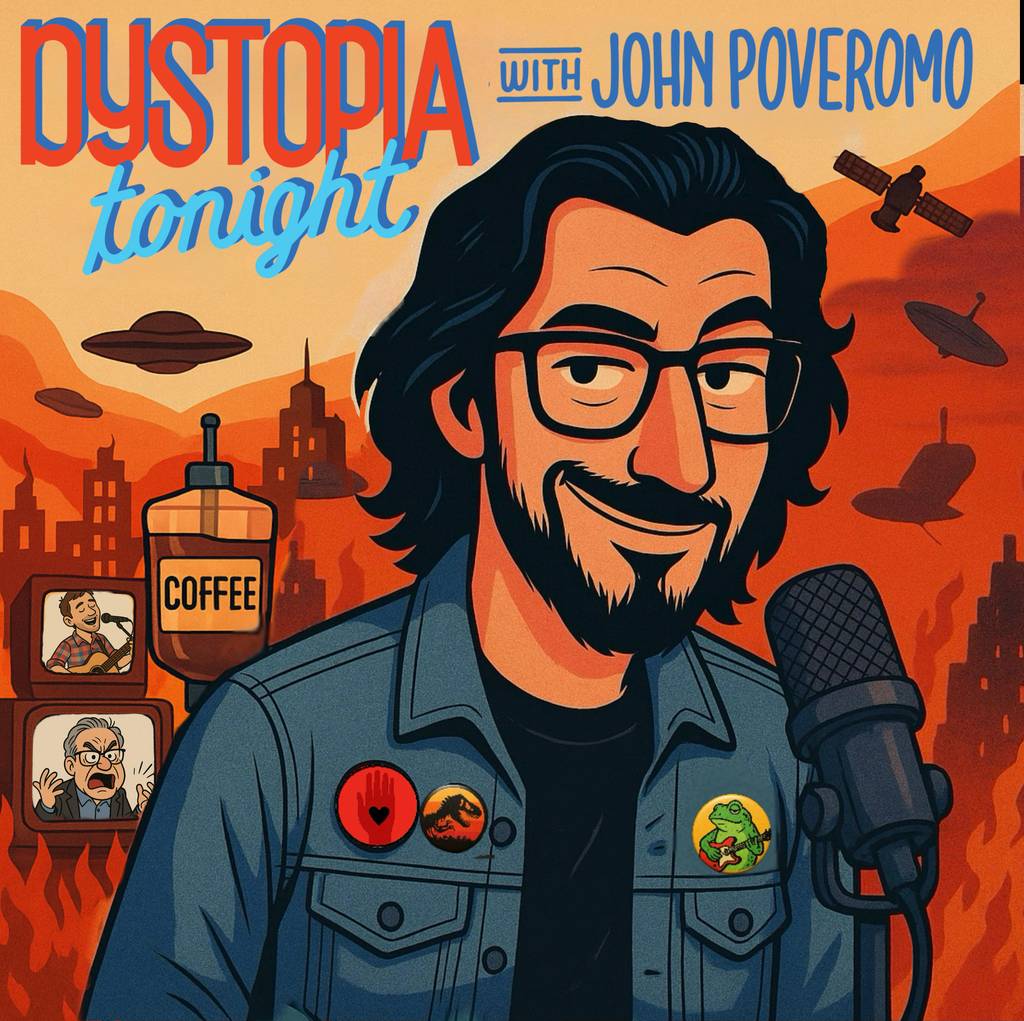
(ASBURY PARK, NJ) -- The Head and the Heart headline a show at The Stone Pony Summer Stage on Thursday, July 31, 2025. The bill also includes sets by Wilderado and Marfa. For fans who purchased the VIP package from the band, they'll see a special Q&A hosted by comedian John Poveromo, host of the popular podcast Dystopia Tonight. We spoke with him to learn more about the Q&A.
How did you get involved with the Q&A?
I’ve been a fan of The Head and the Heart for a while now. There’s a hopefulness in their sound that can be quietly heartbreaking. It’s the kind of music that resonates as something deeply personal, like a feeling you’ve had your whole life suddenly coming into focus. After having Jonathan on my podcast Dystopia Tonight, and then again for an acoustic set and interview to close out my 24-hour MS benefit this past March, this Q&A just made sense. We’ve got a great rapport. He’s quick, funny, and easy to connect with, and I think that came through in our conversations. So when the chance to do this came up, I jumped at it. For me, it’s never just about asking questions. It’s about building community, bringing people in, and making the whole thing feel like a conversation everyone gets to be part of.
Have you done this Q&A elsewhere on their tour?
This is the first time I’m doing it for them, but it’s definitely in my wheelhouse. I’ve done countless interviews with musicians across genres on my show, and I’ve hosted panels, live interviews, even 3 a.m. debates with sleep-deprived comedians during the MS benefit. So I’m used to managing chaos and keeping it engaging. Not that this will be chaotic but it’s my way of saying I’m well prepared.
As a comedian, do you take a different approach to the Q&A? Like is it regular questions or do you bridge the gap between a regular interview and a comedy sketch?
My background in stand-up and interviews lets me approach these moments differently. If I do my job right, it should feel like you’ve stumbled into a really great backstage hang instead of a press junket. You pull the audience in with a little humor, break down the artist-fan wall, and hopefully you get something honest, spontaneous, and offbeat. Whether it’s comedy, conversation, or raising money for a cause, I just want the things I make to have a pulse and really mean something to the people in the room. Which I think is exactly what The Head and The Heart do with their audience every time they perform.
How can people take part in the Q&A? Is it a select VIP group or open to the public?
This one’s part of the band’s VIP experience, so it’s for ticket holders who got the VIP package. It makes the space more intimate, which I love, because it’s not just a bunch of people yelling song requests. It’s fans who are genuinely invested in the band’s story and their work.
How does your experience in stand-up comedy inform the way you conduct interviews or host live Q&As like this one?
Stand-up is all about reading the room — same with hosting. You’ve got to be present. If the crowd’s tight, you loosen them up. If someone says something wild, you follow it down the rabbit hole. Comedy trains you to listen in a way that a lot of people don’t — and that’s the whole point of a good Q&A: listen, follow, explore, and maybe make fun of yourself a little along the way.
Your podcast, Dystopia Tonight, has featured an incredible mix of musicians — from legacy acts to rising indie artists. What draws you to having musicians on the show?
Music is emotional autobiography. And I think musicians are some of the most reflective, curious people out there. Musicians and Comedians have a lot in common. We often share the same stage, have similar road stories and we also tend to process things in real time, so those conversations can go from hilarious to gut-punch real fast. I love that. Also, growing up, I was obsessed with the stories behind the songs. So getting to ask those questions now is like cracking open a time capsule in front of a live audience.
Do you approach musicians differently than comedians or actors on your podcast, and has that influenced how you plan to host this Q&A?
Definitely. With comedians, I’m usually bracing for them to hijack the interview, in the best possible way. We’re wired to chase the joke, so conversations tend to bounce all over. With musicians, it’s a different kind of joy. There’s a deep curiosity on my end because these are people whose lyrics and music have genuinely saved and shaped my life. Every guest I have on the show is someone I personally seek out, so it becomes this long-form conversation with someone I admire, someone I’ve connected to emotionally through their art.
There’s also that old saying: musicians want to be comedians, and comedians want to be musicians. And it’s true. There’s real mutual respect there. I’ve had artists tell me, “When I bomb a joke on stage, I just play a hit and everyone forgets. You’re just up there with nothing but your words. That’s terrifying.” But then I see those same artists absolutely crushing their stage banter and I’m like, “Wait, you get to tell jokes and play songs that move people? What am I even doing with up there? I should at least be banging a symbol or blowing into a recorder, fucking something.”
All of that shapes how I approach the Q&A. I’m not just talking to a band. I’m talking to artists I respect, and I want the audience to feel like they’re in on that connection too.
You’ve had artists like Jonathan Russell on your podcast and involved in your MS benefit stream. How do those collaborations come about — and what makes certain artists feel like kindred spirits in your world?
It usually starts with mutual respect either I’m a fan of theirs or they’ve somehow caught wind of stand-up or the podcast and want in. But when you meet someone who gets what you’re trying to do, like Jonathan did with the benefit, it stops being about “promo” and starts being about shared intention. Those are the best guests and the best humans. They get it.
Is there a specific moment during a music guest’s interview that surprised you or stuck with you? Something that reshaped how you think about art or performance?
My podcast started in the middle of the pandemic, so early on the most interesting thing was getting to talk with artists about how that time completely changed the way they created. One of the first conversations that stuck with me was with Marlana Sheetz from Milo Greene. She was incredibly open about how isolation impacted her process, her mental health, and how she approached music moving forward. Hannah Joy from Middle Kids is another who talked about how lockdown shifted the way they recorded and produced. Those early episodes set the tone for the show — yes, we talk about music and creativity, but the conversations that have stuck with me the most are the ones where artists let themselves be vulnerable.
My conversations with Glen Phillips from Toad the Wet Sprocket and Steven Page, formerly of Barenaked Ladies, also come to mind. Both were separate episodes, but each left a real impression on me. We had great conversations about music and the creative process, but it was when the subject turned to mental health that things really opened up. They spoke honestly about grief, depression, and how those experiences shaped not just their art but their lives. That kind of vulnerability doesn’t always happen, and when it does, it hits differently. It reminds you that the people behind the songs are still navigating life just like the rest of us. I think those moments are incredibly valuable, not just for the audience, but for the artists themselves and for anyone who needs to know they’re not alone in what they’re feeling.
You’ve managed to fuse entertainment and cause-driven work through your livestream benefit. Has that changed your approach to podcasting or comedy in general?
Yeah, it’s impossible to compartmentalize now. Once you see what comedy, music and conversation can actually do — whether it’s raising money, connecting people, or just giving someone a reason to laugh, keep their head up and keep going at 3 a.m. — it’s hard to go back to the idea that this is all just a gig.
Do you see Dystopia Tonight continuing to be a platform that blends humor, conversation, and activism?
Absolutely. Ever since my mom had me watch Live Aid as a kid I thought “Oh ok, we can make art AND use it to benefit people’s lives? That’s it then that’s the whole point.” Plus, we’re living in a time where we need to do multiple things at once as it is. We laugh, rage, mourn, organize, and Dystopia Tonight is just my way of making that feel a little more human and a lot less like a dystopian nightmare in the form of a never ending press conference.
For more on John Poveromo, visit his website at www.johnpoveromo.net.