

Under the volcano: Digging into Winifred's work
Any good cook will tell you that reducing something doesn't always mean diminishing it. Sometimes it's the best way to intensify its personality. Size, we've learned in the era of streaming entertainment on tiny phone screens, does not determine how clearly a thing communicates. If it fills our senses, it can slip right into our bloodstream.
And certain artists are very good at pulling us close. Winifred McNeill is one of them. She’s been praised for her knowledge of history, but her skill at summoning the aesthetic of the ancient world is only the second most important thing about her art. First things first: the painter and sculptor is an expert miniaturizer. “Between Air and Earth,” a retrospective of her varied work at New Jersey City University (100 Culver Ave.), contains lots of little things that make an outsized impression because they’re small. There are pictures hidden in pipes; there are worlds inside shells; there are tiny, endangered friends with whom the viewer have a fleeting relationship.
The artist is a steady hand with a shrink ray — so steady, in fact, that her show doesn’t seem tiny at all. Instead, it’s a wide-screen treat, and a trip to a Pompeii of her own creation, crammed to the corners with discoveries, warnings, jokes, and winks at the audience.
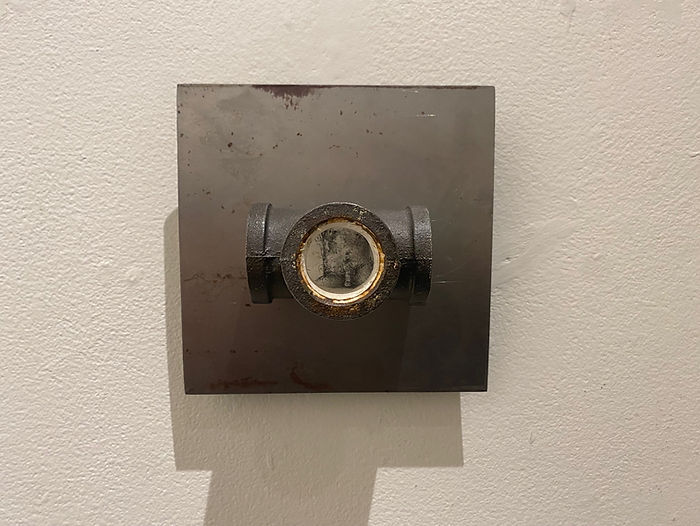
Pipes of peace? McNeill asks you to stoop to see.
Consider, for instance, McNeill’s downsized busts. These porcelain noggins are hardly bigger than a shooter marble. She’s managed to give each one of them a different expression: some heavy-lidded and apple-cheeked, some supercilious, some despairing and others merely fretting, some bearing the imperial swagger we associate with Rome, some irritable in the manner of middle-aged men. Many of them rest on black pedestals attached to long dowels. Others have been plopped down, like maraschino cherries on a cake, on the flat tops of tiny stelae.
In part, this is satire. The sculptor is poking fun at tribunals of self-important authorities, dyspeptic senators, and the gaggles of judges, mostly male, who preside over society. The stone columns cast to resemble memorial towers do not, on close inspection, say anything at all. Instead of Latin letters, McNeil has scored the surface of the porcelain with tally marks. The inscriptions, it turns out, are just as mute as the heads on the pillars.

Part of the tribunal.
Yet the care with which McNeill has rendered these tiny ears, nostrils, and tight lips suggests affection for her supercilious subjects. An awful lot of work and love has gone into assembling this crew and positioning them in a manner that makes their jeopardy clear. Those tapering plinths that raise these characters to eye level look as thin, and snappable, as a pretzel stick. The stelae lean dangerously, and the heads that crown them are poised to topple. Haughty expressions on the faces of the members of this governing elite in porcelain cannot conceal the terrible truth: they’re all one good shake away from shattering. Pointedly, McNeill has mixed volcanic ash into their glaze. Residue of cataclysm is all over their faces.
The miniature porcelain blackbirds that perch together on the south wall of the gallery share austerity — and precarity — with McNeill’s senators. From a distance, they make an impressive flock. Close up, they’re fragile, and maybe even spectral: each one a singular creature with thumb-pressed wings and small, textured bodies, all pointed in the direction of the sky, but vulnerable to gravity. Do they have sufficient loft to make it to their destination? What could they do if they did?

Ancient cephalopod, more recent lizard. Or is it the other way around?
Ghost-animals (and ghost-plants) recur elsewhere in the show. Ocean creatures in indigo ink swim on porcelain panels set afloat in blocks of wall-plaster. The softness of McNeill’s lines and the muted quality of the color makes these animals feel distant, and separated from us by time as well as space. In a larger piece made of plaster of Paris, a pair of seabirds soar high above a turtle depicted below the waterline. The orange flash of sunrise is lovely, and the seascape is placid, but the prevailing mood is one of remoteness. Flora, too, grows mostly in secret places. A ceramic box, artfully cracked open by the sculptor, contains an image of a single tree, wan, exposed to the elements, in a grassy field. Is putting pumice in the glaze a little heavy-handed? Maybe, but it certainly looks nice; period-specific, too. Call it art with terroir.
The artist's igneous inventions are designed to get us to think about Vesuvius, and objects unearthed from archaeological digs. This, in turn, is a metaphor for the impermanence of things, and animals, and people, and civilizations. Busts of emperors split, monuments crumble, keepsakes are lost, homes cave in, and the world moves with disregard for the comfort of its inhabitants. It’s a beautiful disaster area that McNeill is entertaining us with — a still landscape marked by evidence of past turmoil, and haunted by signs of upheaval to come.

Gravitas at three inches: the old Senator cracks up.
No set of omens is complete without a nervous glance at the night sky. My favorite piece in this show is as spooky as a deserted beach in October: nine tiles on boxes of plaster, each painted a deep blue, each sporting a silvery moon, each with a faint trail of light on a cold sea. McNeill has arranged these in a three by three grid, placed the largest and most fiercely haloed moon in the middle, and the tiniest on the bottom. In typical Winifred McNeill style, the smallest leaves the most powerful impression. The stars are freckles on the face of the firmament, but we still believe they spell out our future.
The fate of nations might be up there somewhere, too, spelled out in dots and comet-dashes. The ancient Romans once thought their empire was eternal. Many arrogant Americans believe the same of ours. They don’t feel the earthquake coming; they don’t even notice the erosion. Will beautiful things be left behind, I wonder, once entropy has its way with us?
(“Between Air and Earth” is on view at NJCU until April 9. The gallery is pretty easy to access: there's often somebody in there during normal school hours. To make sure there will be, you can call 201-200-2496.)

Tris McCall regularly writes about visual art (and other topics) for NJArts.net, Jersey City Times, and other independent publications. He's also written for the Newark Star-Ledger, Jersey Beat, the Jersey City Reporter, the Jersey Journal, the Jersey City Independent, Inside Jersey, and New Jersey dot com. He also writes about things that have no relevance to New Jersey. Not today, though.
Eye Level is an online journal dedicated to visual art in Jersey City, New Jersey. A new review will appear every Tuesday morning at 8 a.m., and there'll be intermittent commentaries posted to the site in between those reviews.
Eye Level is made possible by an Andy Warhol Arts Writers Grant.